Edward Prescott, co-winner of the 2004 Nobel Prize in Economics, asks:
Why do Americans work so much more than Europeans?…
Here's a startling fact: Based on labor market statistics from the Organization for Economic Cooperation and Development, Americans aged 15-64, on a per-person basis, work 50% more than the French. Comparisons between Americans and Germans or Italians are similar. What's going on here? What can possibly account for these large differences in labor supply?
The answer? Marginal tax rates. It's a fascinating economic analysis. Read the article (and then go back to work!).
From WSJ online:
Greenspan warned that a further increase in crude-oil prices could risk “more serious negative consequences” for the economy. U.S. retail sales surged 1.5% in September but consumer sentiment soured in October. Producer prices rose 0.1%.
Keep an eye on oil (current spot prices here) … if the rise continues you can expect two “serious negative consequences”—US Airways will be out of business, and Delta will declare bankruptcy.
Living in a “swing state,” our house is being spammed with a heavy, daily dose of political direct mail. Most of them are from the Dems (which is actually a bit of a surprise to me, given that I thought Karl Rove had made direct mail the province of Republicans), and most of them are ridiculously simple-minded and insulting.
But again, it's like advertisers say: If you hate or don't get an ad, it wasn't meant for you.
Regardless, I figured: when you have a surplus, share the love. So I'll be sharing the main messages from the pieces we get, and you can indulge in the same swing-state reading we're getting in PA.
Today's lot:
What are Lois' priorities? Glad you asked. From the mailing:
Welcome to our world …
Spending as much time on airplanes as I do, I particularly enjoyed this MSNBC article on how to avoid talkative seatmates (via FARK).
I'm a big fan of the Headphone Strategy myself … although I thought this was interesting (if a bit strange):
Robert Salmon of Chevy Chase sends a different kind of message. Whenever he flies on Southwest Airlines, Salmon dons on a surgical mask in the boarding area. It’s not that he has a breathing disorder or an infectious disease. Since Southwest has an open-seating policy, Salmon uses the mask to discourage people from sitting next to him. And if someone does wind up beside him, he said the mask pretty much ensures the traveler won’t start chatting away.“It’s very effective. I don’t have to make any excuses about why I don’t want to talk, people just stay away,” said Salmon, a housing constructor.
Hey … I'm sure it works (if you don't mind living a lie) …
I'm struggling with whether I should keep Avocare online … my posting is so infrequent, and I'm so involved in other stuff.
Keep? Kill? Kill? Keep?
Thoughts?
With the presidential debates looming, you might enjoy visiting the online home of the Commission on Presidential Debates.
For the “How Things Have Changed” file: The first debates, held between Lincoln and Douglas in 1858, involved seven debates in seven Illinois congressional districts. The format: each debate lasted three hours; first candidate spoke for one hour; the second for one and a half hours; the first replying for a half hour. Candidates alternated going first.
Byron York, Opinion Journal:
The moral of it all is that it is infinitely more difficult for journalists to make questionable assertions in the age of the blogosphere than it was in years past. There is an army of well-informed fact-checkers out there, all connected on the Internet. There are people who know about things like computer fonts, or IBM typewriters circa 1972, or the arcane terminology of the Air National Guard. Pick a completely different subject, and there will be people who know about that, too.CBS was clearly angry that its judgment was questioned— by nobodies! “You couldn't have a starker contrast between the multiple layers of checks and balances \[at the network\] and a guy sitting in his living room in his pajamas writing,” said one former CBS executive who defended Mr. Rather.
Well, it turned out that the guy in his pajamas was right, at least this time.
As TCP contributor and good friend of the blogosphere N.Z. Bear has said:
That kind of carelessness might have cut it a few years ago, when somnolent Big Media hacks were satisfied to define reporting as getting quotes from both party's spokesmen. But times have changed, friends: there isn't just one new sheriff in town, there's thousands of us. We will fact-check your ass, and we will do it thoroughly and properly, with links and primary sources that let our readers decide where the truth lies. So straighten up and fly right, because we are watching —- and we do this crap for fun.
Cross posted here.
James Fallows continues his acclaimed reporting on Iraq with his latest installment at The Atlantic, Bush's Lost Year (subscription required). This portion caught my eye (and since many readers likely don't have a subscription to The Atlantic, I'm posting a large segment so you get the general thesis):
“Let me tell you my gut feeling,” a senior figure at one of America's military-sponsored think tanks told me recently, after we had talked for twenty minutes about details of the campaigns in Afghanistan and Iraq. “If I can be blunt, the Administration is full of shit. In my view we are much, much worse off now than when we went into Iraq. That is not a partisan position. I voted for these guys. But I think they are incompetent, and I have had a very close perspective on what is happening. Certainly in the long run we have harmed ourselves. We are playing to the enemy's political advantage. Whatever tactical victories we may gain along the way, this will prove to be a strategic blunder.”This man will not let me use his name, because he is still involved in military policy. He cited the experiences of Joseph Wilson, Richard Clarke, and Generals Eric Shinseki and Anthony Zinni to illustrate the personal risks of openly expressing his dissenting view. But I am quoting him anonymously—as I will quote some others—because his words are representative of what one hears at the working level.
To a surprising extent their indictment doesn't concentrate on the aspect of the problem most often discussed in public: exactly why the United States got the WMD threat so wrong. Nor does it involve a problem I have previously discussed in this magazine (see “Blind Into Baghdad,” January/February Atlantic): the Administration's failure, whether deliberate or inadvertent, to make use of the careful and extensive planning for postwar Iraq that had been carried out by the State Department, the CIA, various branches of the military, and many other organizations. Rather, these professionals argue that by the end of 2002 the decisions the Administration had made—and avoided making—through the course of the year had left the nation less safe, with fewer positive options. Step by step through 2002 America's war on terror became little more than its preparation for war in Iraq.
Because of that shift, the United States succeeded in removing Saddam Hussein, but at this cost: The first front in the war on terror, Afghanistan, was left to fester, as attention and money were drained toward Iraq. This in turn left more havens in Afghanistan in which terrorist groups could reconstitute themselves; a resurgent opium-poppy economy to finance them; and more of the disorder and brutality the United States had hoped to eliminate. Whether or not the strong international alliance that began the assault on the Taliban might have brought real order to Afghanistan is impossible to say. It never had the chance, because America's premature withdrawal soon fractured the alliance and curtailed postwar reconstruction. Indeed, the campaign in Afghanistan was warped and limited from the start, by a pre-existing desire to save troops for Iraq.
A full inventory of the costs of war in Iraq goes on. President Bush began 2002 with a warning that North Korea and Iran, not just Iraq, threatened the world because of the nuclear weapons they were developing. With the United States preoccupied by Iraq, these other two countries surged ahead. They have been playing a game of chess, or nerves, against America—and if they have not exactly won, they have advanced by several moves. Because it lost time and squandered resources, the United States now has no good options for dealing with either country. It has fewer deployable soldiers and weapons; it has less international leverage through the “soft power” of its alliances and treaties; it even has worse intelligence, because so many resources are directed toward Iraq.
At the beginning of 2002 the United States imported over 50 percent of its oil. In two years we have increased that figure by nearly 10 percent. The need for imported oil is the fundamental reason the United States must be deferential in its relationship with Saudi Arabia. Revenue from that oil is the fundamental reason that extremist groups based in Saudi Arabia were so rich. After the first oil shocks, in the mid-1970s, the United States took steps that reduced its imports of Persian Gulf oil. The Bush Administration could have made similar steps a basic part of its anti-terrorism strategy, and could have counted on making progress: through most of 2002 the Administration could assume bipartisan support for nearly anything it proposed. But its only such suggestion was drilling in the Arctic National Wildlife Refuge.
Before America went to war in Iraq, its military power seemed limitless. There was less need to actually apply it when all adversaries knew that any time we did so we would win. Now the limits on our military's manpower and sustainability are all too obvious. For example, the Administration announced this summer that in order to maintain troop levels in Iraq, it would withdraw 12,500 soldiers from South Korea. The North Koreans, the Chinese, the Iranians, the Syrians, and others who have always needed to take into account the chance of U.S. military intervention now realize that America has no stomach for additional wars. Before Iraq the U.S. military was turning away qualified applicants. Now it applies “stop-loss” policies that forbid retirement or resignation by volunteers, and it has mobilized the National Guard and Reserves in a way not seen since World War II.
Because of outlays for Iraq, the United States cannot spend $150 billion for other defensive purposes. Some nine million shipping containers enter American ports each year; only two percent of them are physically inspected, because inspecting more would be too expensive. The Department of Homeland Security, created after 9/11, is a vast grab-bag of federal agencies, from the Coast Guard to the Border Patrol to the former Immigration and Naturalization Service; ongoing operations in Iraq cost significantly more each month than all Homeland Security expenses combined. The department has sought to help cities large and small to improve their “first responder” systems, especially with better communications for their fire and emergency medical services. This summer a survey by the U.S. Conference of Mayors found that fewer than a quarter of 231 major cities under review had received any of the aid they expected. An internal budget memo from the Administration was leaked this past spring. It said that outlays for virtually all domestic programs, including homeland security, would have to be cut in 2005—and the federal budget deficit would still be more than $450 billion.
Worst of all, the government-wide effort to wage war in Iraq crowded out efforts to design a broader strategy against Islamic extremists and terrorists; to this day the Administration has articulated no comprehensive long-term plan. It dismissed out of hand any connection between policies toward the Israeli-Palestinian conflict and increasing tension with many Islamic states. Regime change in Iraq, it said, would have a sweeping symbolic effect on worldwide sources of terror. That seems to have been true—but in the opposite way from what the President intended. It is hard to find a counterterrorism specialist who thinks that the Iraq War has reduced rather than increased the threat to the United States.
And here is the startling part. There is no evidence that the President and those closest to him ever talked systematically about the “opportunity costs” and tradeoffs in their decision to invade Iraq. No one has pointed to a meeting, a memo, a full set of discussions, about what America would gain and lose.
 Have you seen this in your pocket or purse yet? They started showing up in my change last week. CNN informs: it's a representation of the “Jefferson Peace Medal. This was a ceremonial medallion presented to Native American chiefs during treaty signings and other big pow-wows.”
Not that we showered peace upon the native peoples … but that's a different post for a different time.
And the change doesn't end there … we're changing the front and back for 2005.
Some people, five weeks pregnant on the day they lose the love of their live in the South Tower of the World Trade Center, would recoil into an emotional hole and become bitter with the world. But not everyone … some, like Tracy Woodall, would instead see in 9/11 motivation to devote their lives to helping autistic children. Want to feel good about something today? Go here to learn about Tracy and strengthen the good.
Friends, family, and colleagues generally know that on the morning of 9.11.01 I was airborne, sitting in a US Airways 737 making way from Philadelphia to Chicago. That flight landed at 7:45 a.m. CDT, three minutes before the first plane hit the North Tower of WTC … which as I figure, makes my arrival one of the last commercial flights to have existed purely in the “old world.”
This past Friday I was again in a US Airways 737, making way from Dallas to Philadelphia, when I cam across this essay by Mark Helprin in the Wall Street Journal. He asks an essential question, “Three years after September 11, where do we stand?” and his response precisely captures the frustration I’ve felt for some months. I’ve posted the full text below.
As you read it, ask yourself: Are we really prosecuting war against Islamic terrorism? Perhaps you can answer the question with another question: “Other than living with greater uncertainty, fear, and economic instability, how has your life changed as a result of our prosecuting war against Islamic terrorism?”
If you are like me, the answer is, “Not at all,” and that, friends, is not war at all.
Three Years On: We still haven't learned the lessons of 9/11.BY MARK HELPRIN, Friday, September 10, 2004 12:01 a.m. EDT
Three years after September 11, where do we stand?
Out of fear and confusion we have hesitated to name the enemy. We proceed as if we are fighting disparate criminals united by coincidence, rather than the vanguard of militant Islam, united by ideology, sentiment, doctrine, and practice, its partisans drawn from Morocco to the Philippines, Chechnya to the Sudan, a vast swath of the earth that, in regard to the elemental beliefs that fuel jihad, is as homogeneous as Denmark.
Too timid to admit to a clash of civilizations even as it occurs, we failed to declare the war, thus forfeiting clarity of intent and the unambiguous consent of the American people. This was a sure way, as in the Vietnam era, to divide the country and prolong the battle.
We failed not only to prepare for war but to provision for it after it had begun, disallowing a military buildup, much less the wartime transformation of the economy. In the First World War our elected representatives decisively resolved that “to bring the conflict to a successful termination all the resources of the country are hereby pledged by the Congress of the United States.” In the Revolutionary War we as a people pledged our lives, our fortunes, and our sacred honor.
What is different now of course is that we are combating neither the British Empire nor Imperial Germany, but an opponent who is fundamentally weak militarily, economically, and, in the long run, ideologically. Still, he has by his near mastery of terrorism and asymmetrical warfare necessitated that we mobilize as if we were in fact fighting a great empire. And yet we have not done so, expending not even the average of 5.7% of GDP we devoted to defense in the peacetime years of the period 1940-2000, but, currently, only 3.6%—as if we were not at war, as if the military technological “revolution” could overcome insurgencies or occupy populous countries, as if China's armed forces were not ascending, as if our territory were invulnerable, and as if terrorism, as some used to think and some still do, can simply be managed.
We have followed a confusion of war aims that seem to report after the fact what we have done rather than to direct what we do. We could, by threatening the existence of Middle Eastern regimes, which live to hold power, enforce our insistence that the Arab world eradicate the terrorists within its midst. Instead, we have embarked upon the messianic transformation of an entire region, indeed an entire civilization, in response to our inability to pacify even a single one of its countries. As long as our war aims stray from the disciplined, justifiable, and attainable objective of self-defense, we will be courting failure.
Our strategy has been deeply inadequate especially in light of the fact that we have refused to build up our forces even as our aims have expanded to the point of absurdity. We might have based in northern Saudi Arabia within easy range of the key regimes that succor terrorism, free to coerce their cooperation by putting their survival in question. Our remounted infantry would have been refreshed, reinforced, properly supported, unaffected by insurgency, and ready to strike. The paradigm would have shifted from conquer, occupy, fail, and withdraw—to strike, return, and re-energize. At the same time, we would not have solicited challenges, as we do now, from anyone who sees that although we may be occupying Iraq, Iraq is also occupying us.
We have abstained from mounting an effective civil defense. Only a fraction of a fraction of our wealth would be required to control the borders of and entry to our sovereign territory, and not that much more to discover, produce, and stockpile effective immunizations, antidotes, and treatments in regard to biological and chemical warfare. Thirty years ago the entire country had been immunized against smallpox. Now, no one is, and the attempt to cover a minuscule part of the population failed miserably and was abandoned. Not only does this state of affairs leave us vulnerable to a smallpox epidemic, it stimulates the terrorists to bring one about. So with civil aviation, which, despite the wreckage and tragedy of September 11, is protected in an inefficient, irresponsible, and desultory fashion.
We have watched the division of the country into two ineffective camps, something that is especially apparent in an electoral season. On the one hand is John Kerry, a humorless Boston scold, in appearance the love child of Abraham Lincoln and Bette Midler, who recites slogans that he understands but does not believe. And on the other is the president, proud of his aversion to making an argument for his own case, in appearance a denizen of the Pleistocene, who recites slogans that he believes but does not understand.
At this point the American people, who most of the time are wiser than the experts or politicians who briefly take the helm, may already have decided to reinstall the president despite his shortcomings. If this is so, it is because Sen. Kerry's main motive power has come from those who are foolish enough to exult in the crude and baseless propaganda of a freakish Leni Riefenstahl wannabe (too heavy), and because, in what may have been his campaign's defining moment, Sen. Kerry stated that he learned a long time ago that when under attack you turn your boat toward the enemy. And yet it is clear from his record, his character, and his present policy that this is precisely what he would not do. Nor, though it is exactly what the country should do, is it at all what his most enthusiastic partisans or the base of the Democratic Party would want him to do.
He and they have adopted simultaneously two opposing propositions and embraced two opposing tendencies, which they then present to the electorate as if there is no contradiction. They do not feel acutely, as others do, the dissonance of their positions, because they truly believe in only the less martial of the two.
Although they cannot state why the American, British, Spanish, and Australian invasion of Iraq was any more or less unilateral or multilateral than France, Germany, and Belgium working to derail that invasion, or deny that they admire Britain for standing alone, unilaterally, in 1940, or that the multilateral Axis invasion of Greece was wrong, or that they themselves urge unilateral American action to stop genocide in Africa, they use these words fervently and without logic. They may believe that this is their subtlety, but it is nothing more than confusion and a stylish capitulation to the French, who unfortunately are perfectly willing to capitulate to Islamic terrorism as long as France has purchased its own safety, as of old.
Given the lack of movement in the war and poverty of choice in leadership, Americans looked to a commission. Like the senescent Ottomans we waited and waited as the seasons passed, and were presented neither with swelling armies, well defended borders, nor a string of victories. Although the bravest commissioners of said commission fought to tell us that we are indeed in a clash of civilizations, even they, appointed by their respective parties, did not state the simple unvarnished truth that for 20 years administrations both Republican and Democratic have ignored or misread the evidence concerning terrorism and must be judged negligent and culpable.
The president could have said this, and in doing so clarified the course ahead and won the trust of the people. The commission could have said it simply and directly, but did not. Instead, it offered the labored and nearly impertinent conclusion that the way to prevail in this war is to rearrange the organizational table of the intelligence agencies. Many of its reforms are questionable on their face, most would have merely a neutral effect on the substance of intelligence, and the emphasis is mistaken. Like those who want to fight the war by funding fire departments—knife attacks are not defeated by bandages, and the Battle of Britain was not won by the London Fire Brigades—the commission looked upon one aspect as if it were the essential element, which it is not.
The more good intelligence the better, but because the enemy moves in small groupings he will on occasion, as intelligence is not perfect, elude it. That is why difficult, expensive, inefficient, and general defensive screens are necessary, and why we cannot rely only on pinpoint intelligence even if it is both fashionable and economical. In stressing intelligence, the commission slights elements of equal or greater importance that led to September 11 in the first place. Had the airport screeners been competent, had cockpit doors been reinforced, had the borders been properly controlled, the thousands who were lost that day, and who are loved, would still be alive.
Neither the commission, the president, nor the Democratic nominee has a clear vision of how to fight and defend in this war. Partly this is because so many Americans do not yet feel, as some day they may, the gravity of what we are facing.
Three years on, that is where we stand: our strategy shiftless, reactive, irrelevantly grandiose; our war aims undefined; our preparations insufficient; our civil defense neglected; our polity divided into support for either a hapless and incompetent administration that in a parliamentary system would have been turned out long ago, or an opposition so used to appeasement of America's rivals, critics, and enemies that they cannot even do a credible job of pretending to be resolute.
Blogging 101 - An introduction to reading and writing a weblog, by Anton Zuiker.
I'm back from Boston and recovering from an exhausting week. To read my first-person account visit the TCP 2004 page, and to see the visuals visit the photoblog.
It was a singular experience. I'm credentialed for the RNC as well, so look for similar stuff from NYC at the end of the month.
The 1964 RNC in San Francisco was an interesting convention for the Republicans. Barry Goldwater and William Miller were the ticket, Goldwater gave a convention speech that is regarded as one of the 100 best American political speeches of that century, and pandemonium repeatedly broke out on the convention floor.
 One of the people reporting this pandemonium was legendary journalist John Chancellor, who, in a moment made instantly famous by the images of television, said as he was physically removed from the floor, “Here we go down the middle aisle … I've been promised bail, ladies and gentlemen, by my office. This is John Chancellor, somewhere in custody.”
It was an important moment in journalism: a staid institution, the RNC, was attempting to control a new medium and was quickly learning it could not … that ultimately, they had to embrace a medium they could no longer control. It was a stark contrast to the DNC just four years later, when TV openly captured every hostile and shocking moment in Chicago, and conventions (and the world for that matter) changed for forever.
I think of that moment, John Chancellor being lifted from his feet, radio on his back, wires dangling, as I consider the invitation of bloggers by the DNC (a path the RNC, we presume, we follow). We’re quite the story this year, we few credentialed bloggers. I’ve had two reporters tell me that they believe we’re the story in Boston, the “hot house flowers” in an otherwise “news-less convention,” as one said, forecasting “about a billion cameras” at the blogger breakfast tomorrow morning (sorry I’ll miss it … I’ll explain later).
My response, though, was that we’re NOT the real story here. The real story is not that the Political Machine decided to officially extend access to citizen journalists by extending a select few press credentials … the real story is that they already, although unknowingly, had.
At last count, there are 11 DNC delegates or DNC officials, with full access to the convention, who also happen to blog:
One would expect that these bloggers, especially the mainstream delegates, will blog the convention. And it’s here that we find the main point: the decision to extend press credentials to select bloggers was a false choice … the convention in Boston was going to be blogged, from the floor and by citizens with no editorial board, whether I or any other blogger received credentials or not. I presume the same will be true in New York this August.
I’m not saying the credentialing decision wasn’t significant … it did give a small group of non-professional, non-party-official citizens a window into a forum not otherwise available, and it does indicate that blogs have achieved a form of legitimacy among the media. But the REAL sign of the medium’s legitimacy isn’t that we were given the opportunity … it’s that the opportunity is purely symbolic in its importance.
In 1964, the Republicans learned that, try as they might, the time in which they could choose their level of TV news inclusion had long passed. The same is true for the DNC and RNC for blogs forty years later. It doesn’t matter if I or Dave Winer or anybody else is there … blogger delegates already will be, and will be with greater access than any of us.
To me, this false choice is the real indication that blogging has “arrived.” We’re becoming pervasive. In time, no forum of significance will be a forum without a blogger, and the result will be even greater transparency, openness, and democratization of information. And the convention committees aren’t the only ones facing the consequences: all staid institutions face the same false choice … we saw it in Iraq, and we’ll increasingly see it in China, Iran, Microsoft, and the Pentagon.
The printing press made us readers, the personal computer made us writers, and now, with weblogs, the Internet is making us reporters. The conventions will be blogged … of course they will … whether the DNC and RNC wish it or not, and they can never again remove the reporters from the floor.
(Cross-posted here.)
Foreign Policy writer Parag Khanna:
According to Michael Flocker's 2003 bestseller, The Metrosexual Guide to Style: A Handbook for the Modern Man, the trendsetting male icons of the 21st century must combine the coercive strengths of Mars and the seductive wiles of Venus. Put simply, metrosexual men are muscular but suave, confident yet image-conscious, assertive yet clearly in touch with their feminine sides. Just consider British soccer star David Beckham. He is married to former Spice Girl Victoria “Posh” Adams, but his combination of athleticism and cross-dressing make him a sex symbol to both women and men worldwide, not to mention the inspiration for the 2002 hit movie Bend It Like Beckham. Substance, Beckham shows, is nothing without style.Geopolitics is much the same. American neoconservatives such as Robert Kagan look down upon feminine, Venus-like Europeans, gibing their narcissistic obsession with building a postmodern, bureaucratic paradise. The United States, by contrast, supposedly carries the mantle of masculine Mars, boldly imposing freedom in the world's nastiest neighborhoods. But by cleverly deploying both its hard power and its sensitive side, the European Union (EU) has become more effective”and more attractive”than the United States on the catwalk of diplomatic clout. Meet the real New Europe: the world's first metrosexual superpower.
That's what our ForPol needs: better shoes.
I'm not certain how I've missed this, but Jeff Jarvis, who publishes Buzz Machine among his many projects, has posted his first-person account of the 9/11 WTC attack here. Jeff is a top-notch reporter, and I can only describe it as compelling listening.
What does one find at the critical juncture of fandom, popular mythology, and the Internet? The The Annotated “American Pie” FAQ. Everything you speculated about while “of the condition,” and then some. Via AEB.
Who needs Photoshop contests when you have this, courtesy the AP?
US Secretary of State Colin Powell, performs a version of the Village People disco hit song 'YMCA' at the conclusion of Asia's largest security meeting in Jakarta, Indonesia, on Friday July 2, 2004. Powell took to the stage, dressed as a construction worker Friday, with other unidentified US diplomats to deliver their rendition of the 1970's hit song to an audience of Asia Security meeting delegates.
You don't think I'd post this without photos, do you? These are thumbnails … click 'em to see them full-sized.


(Cross-posted here.)
I took a bunch of photos while in Brighton, UT last week, and they're starting to make their way onto the photoblog. Pay a visit, and don't hesitate to offer feedback in the comments.
I've made the move to comment registration to limit spam (this spam, not this spam) on the site. For those who don't know, the people peddling Cialis and penis enlargement (two great tastes that go great together!) like to write automated computer programs that submit spam comments pitching their wares on blog post comment threads. I was getting 10 or so of these comments added to the site each day, and since I had upgraded to Movable Type 3.0 anyway (yes, license paid), I switched to the TypeKey comment authentication service as well.
It's easy, free, and fast. The next time you submit a comment, you'll be asked to log in (if you already have a TypeKey identity) or to register (if you don't). I provide a link for both in the comment window, and as I said before, it's fast, easy, and free, and you get to rest better knowing that you're helping to stop spammer scum. It's a one-time deal: once you've registered, you never need to again, and what's more, you should only need to log in once, as the service will put a cookie on your PC remembering your registration information.
Easy authentication for you, less spam for me. Everyone wins. Thanks in advance for registering, and I look forward to reading your spam-free comments.
From the comment thread in my recent rhetoric of Reagan post:
a mediocre actor can be remembered as a good president by putting excellent people in place and saying his lines well
Working with a large number of senior executives as I do, it occurs to me that they and many management theorists would read that comment and say it’s a perfect description of the effective chief executive:
I think part of the problem with our expectations for the Office of the President is that we presume the person who holds it should be a “hands on” leader. “Hands on” is a relative concept for an executive office. Good executives are hands on in matters of vision, philosophy, values, and strategy … but with execution, they get the hell out of the way and let their operational leads do their jobs.
This was Carter's problem: none of the former, all of the latter, and he nearly micromanaged the government to death. One of Reagan's failings was that he was appropriately hands off, but didn't necessarily hold his direct reports accountable for living the same value system … and we got Ollie North as a result.
But on the whole, I think history will show that the Reagan model is the right one for the office, especially in an increasingly complex world: manage as an executive, not as a legislator (who drafts, but does not set, policy) or operational lead (who implements, but does not set, policy). At first blush, it strikes me that Clinton was better than Carter and Ford in this regard, but was at times too involved in policy implementation (Hillary with healthcare). Nixon was in the end a disaster because of this … his paranoia-fed micromanagement went so far he tried to fix the election. LBJ was excellent in his domestic policy … he took stands based on a set of values and let his Legislative Affairs group push the resulting agenda through Congress … but his micromanagement of Vietnam was extraordinary.
It's an interesting dynamic, expecting our President to literally “run” the country when that's really not the job. A better metaphor is “producer/director” from the film industry: he/she should produce and articulate the “what and why” of foreign and domestic policy direction, and should play a slightly more active role directing foreign policy as he/she is the primary negotiator of State in many affairs. But “run” the country? No.
So looking at the choice this time around, one of the things I’m considering is “who’s the better CEO?” Everyone from the conservative camp (and some liberals as well) say this is a Bush strength: he sets direction and gets out of the way.
That said, I think there’s a legitimate cause for concern in his management style: A good CEO sets direction and creates a strong team to execute, but he/she also fosters … hell, encourages … creative dissent and productive confrontation among that team so the group doesn’t fall victim to groupthink. The markers of groupthink? They include:
A similar pitfall, especially dangerous for executive officers, is what Sydney Finkelstein here calls “wooden-headedness”: the practice of “relying on preconceived fixed notions while ignoring or rejecting any contrary signs” (a term originally coined by historian Barbara Tuchman).
The Bush administration is famous … no, infamous … for its ability to speak as a single voice, and according to some, squelch dissent among the ranks (fear of Karl Rove, perhaps? If you haven't yet read this Nicholas Lemann profile, do so now). This is certainly the message Bob Woodward has been spinning in pitching his most recent book: that the nucleus around Bush is extremely small, extremely tight, and extremely aggressive about creating and promoting a single point of view.
Consider the management of post-invasion Iraq. Does anything feel like “relying on preconceived fixed notions while ignoring or rejecting any contrary signs” to you?
I noted a few posts back that Villanova, which fielded Big Bird, had lost “battling commencement addresses” to Penn, which fielded Bono. Now I see that William and Mary fielded John Stuart, and all I can say is: Don't judge an address by its headline.
Here's a sample; the whole thing is in the extended entry. Enjoy.
But here’s the good news. You fix this thing, you’re the next greatest generation, people. You do this—and I believe you can—you win this war on terror, and Tom Brokaw’s kissing your ass from here to Tikrit, let me tell ya. And even if you don’t, you’re not gonna have much trouble surpassing my generation. If you end up getting your picture taken next to a naked guy pile of enemy prisoners and don’t give the thumbs up you’ve outdid us.We declared war on terror. We declared war on terror—it’s not even a noun, so, good luck. After we defeat it, I’m sure we’ll take on that bastard ennui.
But obviously that’s the world. What about your lives? What piece of wisdom can I impart to you about my journey that will somehow ease your transition from college back to your parents' basement?
I know some of you are nostalgic today and filled with excitement and perhaps uncertainty at what the future holds. I know six of you are trying to figure out how to make a bong out of your caps. I believe you are members of Psi U. Hey that did work, thank you for the reference.
So I thought I’d talk a little bit about my experience here at William and Mary. It was very long ago, and if you had been to William and Mary while I was here and found out that I would be the commencement speaker 20 years later, you would be somewhat surprised, and probably somewhat angry. I came to William and Mary because as a Jewish person I wanted to explore the rich tapestry of Judaica that is Southern Virginia. Imagine my surprise when I realized “The Tribe” was not what I thought it meant.
Thank you Mr. President, I had forgotten how crushingly dull these ceremonies are. Thank you.
My best to the choir. I have to say, that song never grows old for me. Whenever I hear that song, it reminds me of nothing.
I am honored to be here, I do have a confession to make before we get going that I should explain very quickly. When I am not on television, this is actually how I dress. I apologize, but there’s something very freeing about it. I congratulate the students for being able to walk even a half a mile in this non-breathable fabric in the Williamsburg heat. I am sure the environment that now exists under your robes, are the same conditions that primordial life began on this earth.
I know there were some parents that were concerned about my speech here tonight, and I want to assure you that you will not hear any language that is not common at, say, a dock workers union meeting, or Tourrett’s convention, or profanity seminar. Rest assured.
I am honored to be here and to receive this honorary doctorate. When I think back to the people that have been in this position before me from Benjamin Franklin to Queen Noor of Jordan, I can’t help but wonder what has happened to this place. Seriously, it saddens me. As a person, I am honored to get it; as an alumnus, I have to say I believe we can do better. And I believe we should. But it has always been a dream of mine to receive a doctorate and to know that today, without putting in any effort, I will. It’s incredibly gratifying. Thank you. That’s very nice of you, I appreciate it.
I’m sure my fellow doctoral graduates—who have spent so long toiling in academia, sinking into debt, sacrificing God knows how many years of what, in truth, is a piece of parchment that in truth has been so devalued by our instant gratification culture as to have been rendered meaningless—will join in congratulating me. Thank you.
But today isn’t about how my presence here devalues this fine institution. It is about you, the graduates. I’m honored to be here to congratulate you today. Today is the day you enter into the real world, and I should give you a few pointers on what it is. It’s actually not that different from the environment here. The biggest difference is you will now be paying for things, and the real world is not surrounded by three-foot brick wall. And the real world is not a restoration. If you see people in the real world making bricks out of straw and water, those people are not colonial re-enactors—they are poor. Help them. And in the real world, there is not as much candle lighting. I don’t really know what it is about this campus and candle lighting, but I wish it would stop. We only have so much wax, people.
Lets talk about the real world for a moment. We had been discussing it earlier, and I…I wanted to bring this up to you earlier about the real world, and this is I guess as good a time as any. I don’t really know to put this, so I’ll be blunt. We broke it.
Please don’t be mad. I know we were supposed to bequeath to the next generation a world better than the one we were handed. So, sorry.
I don’t know if you’ve been following the news lately, but it just kinda got away from us. Somewhere between the gold rush of easy internet profits and an arrogant sense of endless empire, we heard kind of a pinging noise, and uh, then the damn thing just died on us. So I apologize.
But here’s the good news. You fix this thing, you’re the next greatest generation, people. You do this—and I believe you can—you win this war on terror, and Tom Brokaw’s kissing your ass from here to Tikrit, let me tell ya. And even if you don’t, you’re not gonna have much trouble surpassing my generation. If you end up getting your picture taken next to a naked guy pile of enemy prisoners and don’t give the thumbs up you’ve outdid us.
We declared war on terror. We declared war on terror—it’s not even a noun, so, good luck. After we defeat it, I’m sure we’ll take on that bastard ennui.
But obviously that’s the world. What about your lives? What piece of wisdom can I impart to you about my journey that will somehow ease your transition from college back to your parents' basement?
I know some of you are nostalgic today and filled with excitement and perhaps uncertainty at what the future holds. I know six of you are trying to figure out how to make a bong out of your caps. I believe you are members of Psi U. Hey that did work, thank you for the reference.
So I thought I’d talk a little bit about my experience here at William and Mary. It was very long ago, and if you had been to William and Mary while I was here and found out that I would be the commencement speaker 20 years later, you would be somewhat surprised, and probably somewhat angry. I came to William and Mary because as a Jewish person I wanted to explore the rich tapestry of Judaica that is Southern Virginia. Imagine my surprise when I realized “The Tribe” was not what I thought it meant.
In 1980 I was 17 years old. When I moved to Williamsburg, my hall was in the basement of Yates, which combined the cheerfulness of a bomb shelter with the prison-like comfort of the group shower. As a freshman I was quite a catch. Less than five feet tall, yet my head is the same size it is now. Didn’t even really look like a head, it looked more like a container for a head. I looked like a Peanuts character. Peanuts characters had terrible acne. But what I lacked in looks I made up for with a repugnant personality.
In 1981 I lost my virginity, only to gain it back again on appeal in 1983. You could say that my one saving grace was academics where I excelled, but I did not.
And yet now I live in the rarified air of celebrity, of mega stardom. My life a series of Hollywood orgies and Kabala center brunches with the cast of Friends. At least that’s what my handlers tell me. I’m actually too valuable to live my own life and spend most of my days in a vegetable crisper to remain fake news anchor fresh.
So I know that the decisions that I made after college worked out. But at the time I didn’t know that they would. See college is not necessarily predictive of your future success. And it’s the kind of thing where the path that I chose obviously wouldn’t work for you. For one, you’re not very funny.
So how do you know what is the right path to choose to get the result that you desire? And the honest answer is this. You won’t. And accepting that greatly eases the anxiety of your life experience.
I was not exceptional here, and am not now. I was mediocre here. And I’m not saying aim low. Not everybody can wander around in an alcoholic haze and then at 40 just, you know, decide to be president. You’ve got to really work hard to try to…I was actually referring to my father.
When I left William and Mary I was shell-shocked. Because when you’re in college it’s very clear what you have to do to succeed. And I imagine here everybody knows exactly the number of credits they needed to graduate, where they had to buckle down, which introductory psychology class would pad out the schedule. You knew what you had to do to get to this college and to graduate from it. But the unfortunate, yet truly exciting thing about your life, is that there is no core curriculum. The entire place is an elective. The paths are infinite and the results uncertain. And it can be maddening to those that go here, especially here, because your strength has always been achievement. So if there’s any real advice I can give you it’s this.
College is something you complete. Life is something you experience. So don’t worry about your grade, or the results or success. Success is defined in myriad ways, and you will find it, and people will no longer be grading you, but it will come from your own internal sense of decency which I imagine, after going through the program here, is quite strong…although I’m sure downloading illegal files…but, nah, that’s a different story.
Love what you do. Get good at it. Competence is a rare commodity in this day and age. And let the chips fall where they may.
And the last thing I want to address is the idea that somehow this new generation is not as prepared for the sacrifice and the tenacity that will be needed in the difficult times ahead. I have not found this generation to be cynical or apathetic or selfish. They are as strong and as decent as any people that I have met. And I will say this, on my way down here I stopped at Bethesda Naval, and when you talk to the young kids that are there that have just been back from Iraq and Afghanistan, you don’t have the worry about the future that you hear from so many that are not a part of this generation but judging it from above.
And the other thing….that I will say is, when I spoke earlier about the world being broke, I was somewhat being facetious, because every generation has their challenge. And things change rapidly, and life gets better in an instant.
I was in New York on 9-11 when the towers came down. I lived 14 blocks from the twin towers. And when they came down, I thought that the world had ended. And I remember walking around in a daze for weeks. And Mayor Giuliani had said to the city, “You’ve got to get back to normal. We’ve got to show that things can change and get back to what they were.”
And one day I was coming out of my building, and on my stoop, was a man who was crouched over, and he appeared to be in deep thought. And as I got closer to him I realized, he was playing with himself. And that’s when I thought, “You know what, we’re gonna be OK.”
Thank you. Congratulations. I honor you. Good Night.
When I was 17 or so, I was ranting about some piece of US foreign policy when my father looked at me with level eyes and said, “Buddy, if you’re not a liberal when you’re 18 you got no heart, and if you’re not a conservative by the time you're 28 you got no brain.”
Reagan was president then, and I was not a big fan. Now that I’m well into my mid-30s (“middle aged,” my wife says), I’ve come to appreciate and admire Reagan. He was the essential optimist at a time in which America desperately needed optimism. At a time when Jimmy Carter was telling us we should be confident, Reagan gave us reasons to be confident, and led the way through his own confidence and optimism. Many presidents have spoken of the shining city on the hill; Reagan truly believed in it.
I’ve also come to admire Reagan for his fundamental belief in the power of rhetoric … rhetoric in the classical sense, not the current and bastardized sense of double talk by evasive politicians. Reagan understood and respected the power of his words, and he understood better than anyone since FDR (yes, better than Kennedy) the power of presidential discourse in making great things possible.
Reagan has six speeches listed in American Rhetoric’s list of the 100 most significant American political speeches of the 20th century (the list was complied by two professors of Rhetoric and Communication, who asked 137 leading scholars of American public address to recommend speeches on the basis of social and political impact, and rhetorical artistry):
Only FDR and JFK have as many on the list. Some people, though, try to taint Reagan’s oratory as less substantive than some of his predecessors. These people remember him as the Actor President, noting with a curled lip that Reagan was all sizzle and no steak. But they forget that his most noted speeches were policy speeches wrapped in soaring oratory, and not soaring oratory alone.
Let’s take them one at a time.
The Time for Choosing speech, a campaign address in support of Barry Goldwater during the 1964 campaign, is actually in speech in which Reagan outlines what would become the Republican agenda 20 years later: the importance of small government over large, of empowering individuals to pursue their own interests, and of preserving America as “the last best hope for man on Earth” through winning the Cold War. He said that day:
You and I know and do not believe that life is so dear and peace so sweet as to be purchased at the price of chains and slavery. If nothing in life is worth dying for, when did this begin—just in the face of this enemy? Or should Moses have told the children of Israel to live in slavery under the pharaohs? Should Christ have refused the cross? Should the patriots at Concord Bridge have thrown down their guns and refused to fire the shot heard 'round the world? The martyrs of history were not fools, and our honored dead who gave their lives to stop the advance of the Nazis didn't die in vain. Where, then, is the road to peace? Well, it's a simple answer after all.You and I have the courage to say to our enemies, “There is a price we will not pay.” There is a point beyond which they must not advance. This is the meaning in the phrase of Barry Goldwater's “peace through strength.” Winston Churchill said that “the destiny of man is not measured by material computation. When great forces are on the move in the world, we learn we are spirits—not animals.” And he said, “There is something going on in time and space, and beyond time and space, which, whether we like it or not, spells duty.”
You and I have a rendezvous with destiny. We will preserve for our children this, the last best hope of man on Earth, or we will sentence them to take the last step into a thousand years of darkness.
The “Putting America Back to Work” speech is remembered first as an eloquent and vital inaugural address, but in it Reagan declared his intentions to reduce the size of the federal government, return power to the states, reduce taxes, strengthen the country’s ties with its allies, and act with force in the world if required. This speech also closes with these lines, some of the greatest presidential rhetoric ever spoken:
This is the first time in our history that this ceremony has been held, as you’ve been told, on this West Front of the Capitol.Standing here, one faces a magnificent vista, opening up on this city’s special beauty and history. At the end of this open mall are those shrines to the giants on whose shoulders we stand. Directly in front of me, the monument to a monumental man. George Washington, father of our country. A man of humility who came to greatness reluctantly. He led America out of revolutionary victory into infant nationhood. Off to one side, the stately memorial to Thomas Jefferson. The Declaration of Independence flames with his eloquence. And then beyond the Reflecting Pool, the dignified columns of the Lincoln Memorial. Whoever would understand in his heart the meaning of America will find it in the life of Abraham Lincoln.
Beyond those moments, monuments to heroism is the Potomac River, and on the far shore the sloping hills of Arlington National Cemetery with its row upon row of simple white markers bearing crosses or Stars of David. They add up to only a tiny fraction of the price that has been paid for our freedom.
Each on of those markers is a monument to the kind of hero I spoke of earlier. Their lives ended in places called Belleau Wood, the Argonne, Omaha Beach, Salerno and halfway around the world on Guadalcanal, Tarawa, Pork Chop Hill, the Chosin Reservoir, and in a hundred rice paddies and jungles of a place called Vietnam. Under such a marker lies a young man, Martin Treptow, who left his job in a small town barber shop in 1917 to go to France with the famed Rainbow Division.
There, on the Western front, he was killed trying to carry a message between battalions under heavy fire.
We are told that on his body was found a diary. On the flyleaf under the heading, “My Pledge,” he had written these words: “America must win this war. Therefore I will work, I will save, I will sacrifice, I will endure, I will fight cheerfully and do my utmost, as if the issue of the whole struggle
depended on me alone.”The crisis we are facing today does not require of us the kind of sacrifice that Martin Treptow and so many thousands of others were called upon to make. It does require, however, our best effort, and our willingness to believe in ourselves and to believe in our capacity to perform great deeds; to believe that together with God’s help we can and will resolve the problems which now confront us.
And after all, why shouldn’t we believe that? We are Americans.
Compare those words to these from Carter’s “Crisis of Confidence” speech …
We are at a turning point in our history. There are two paths to choose. One is a path I’ve warned about tonight, the path that leads to fragmentation and self-interest. Down that road lies a mistaken idea of freedom, the right to grasp for ourselves some advantage over others. That path would be one of constant conflict between narrow interests ending in chaos and immobility. It is a certain route to failure.All the traditions of our past, all the lessons of our heritage, all the promises of our future point to another path — the path of common purpose and the restoration of American values. That path leads to true freedom for our nation and ourselves. We can take the first steps down that path as we begin to solve our energy problem.
Energy will be the immediate test of our ability to unite this nation, and it can also be the standard around which we rally. On the battlefield of energy we can win for our nation a new confidence, and we can seize control again of our common destiny.
The answer to America’s crisis of confidence is … energy policy? Compare these two speeches and the difference between telling Americans to be confident and giving them a reason for confidence should be clear.
I vividly remember the Evil Empire speech, and in particular I remember thinking “this maniac is trying to get us all killed.” But what Reagan was doing in this speech before evangelical Christians was sending a message to the Soviets that the policy of the United States would not be one of a nuclear freeze … that to do so would reward the USSR for its military buildup. Reagan knew the Soviets supported a freeze because it would freeze their military advantage, and more important, would free their economy from an arms race they could not afford. In this speech he was letting the Soviets know he knew, and that he wasn’t going to fall for it.
We will never give away our freedom. We will never abandon our belief in God. And we will never stop searching for a genuine peace. But we can assure none of these things America stands for through the so-called nuclear freeze solutions proposed by some.The truth is that a freeze now would be a very dangerous fraud, for that is merely the illusion of peace. The reality is that we must find peace through strength.
I would agree to a freeze if only we could freeze the Soviets' global desires. A freeze at current levels of weapons would remove any incentive for the Soviets to negotiate seriously in Geneva and virtually end our chances to achieve the major arms reductions which we have proposed. Instead, they would achieve their objectives through the freeze.
A freeze would reward the Soviet Union for its enormous and unparalleled military buildup. It would prevent the essential and long overdue modernization of United States and allied defenses and would leave our aging forces increasingly vulnerable. And an honest freeze would require extensive prior negotiations on the systems and numbers to be limited and on the measures to ensure effective verification and compliance. And the kind of a freeze that has been suggested would be virtually impossible to verify. Such a major effort would divert us completely from our current negotiations on achieving substantial reductions.
He was also letting his allies and enemies know the gravity he attached to the Cold War: that he saw it not simply as an imperial arms race, but as a battle of philosophy regarding the freedom and potential of man. He was saying to his peers worldwide: “Liberty=Good, Totalitarianism=Bad, and I’m never going to forget it, so don’t ever expect me to let up on the pressure.”
The “Boys of Pointe du Hoc” speech, which Reagan gave 20 years ago today at the 40th D-Day anniversary in 1984, is one of his most eloquent. But this too was a policy speech. After showering appropriate praise upon the Rangers who climbed those cliffs 60 years ago, Reagan let the USSR and western Europe know that the policy of the United States would be to welcome improved relations with the Soviets, but that they must first change their ways. As he said then:
It's fitting to remember here the great losses also suffered by the Russian people during World War II: 20 million perished, a terrible price that testifies to all the world the necessity of ending war. I tell you from my heart that we in the United States do not want war. We want to wipe from the face of the earth the terrible weapons that man now has in his hands. And I tell you, we are ready to seize that beachhead. We look for some sign from the Soviet Union that they are willing to move forward, that they share our desire and love for peace, and that they will give up the ways of conquest. There must be a changing there that will allow us to turn our hope into action.
It was then that he articulated the second point of policy: than until that change came, the US would actively strengthen the NATO alliance.
The “Space Shuttle Challenger” address was poetry, not policy, but it demonstrated the power of the president to salve our wounds during times of national grief … perhaps the most eloquent such example since Lincoln’s second inaugural address. Even here, though, he offered vision and outlined our direction as a nation:
And I want to say something to the schoolchildren of America who were watching the live coverage of the shuttle's take-off. I know it's hard to understand, but sometimes painful things like this happen. It's all part of the process of exploration and discovery. It's all part of taking a chance and expanding man's horizons. The future doesn't belong to the fainthearted; it belongs to the brave. The Challenger crew was pulling us into the future, and we'll continue to follow them.I've always had great faith in and respect for our space program. And what happened today does nothing to diminish it. We don't hide our space program. We don't keep secrets and cover things up. We do it all up front and in public. That's the way freedom is, and we wouldn't change it for a minute.
We'll continue our quest in space. There will be more shuttle flights and more shuttle crews and, yes, more volunteers, more civilians, more teachers in space. Nothing ends here; our hopes and our journeys continue.
Finally, the “Tear Down This Wall” speech, delivered in 1987. This speech represents the third element of what, along with the Evil Empire and Pointe du Hoc speeches, became a triumvirate of Cold War policy addresses by Reagan. That day he said:
We hear much from Moscow about a new policy of reform and openness. Some political prisoners have been released. Certain foreign news broadcasts are no longer being jammed. Some economic enterprises have been permitted to operate with greater freedom from state control. Are these the beginnings of profound changes in the Soviet state? Or are they token gestures, intended to raise false hopes in the West, or to strengthen the Soviet system without changing it? We welcome change and openness; for we believe that freedom and security go together, that the advance of human liberty can only strengthen the cause of world peace.There is one sign the Soviets can make that would be unmistakable, that would advance dramatically the cause of freedom and peace. General Secretary Gorbachev, if you seek peace , if you seek prosperity for the Soviet Union and Eastern Europe, if you seek liberalization: Come here to this gate! Mr. Gorbachev, tear down this wall!
In Europe, only one nation and those it controls refuse to join the community of freedom. Yet, in this age of redoubled economic growth, of information and innovation, the Soviet Union faces a choice: It must make fundamental changes, or it will become obsolete. Today thus represents a moment of hope. We in the West stand ready to cooperate with the East to promote true openness, to break down barriers that separate people, to create a safer, freer world.
In this speech he completes his Cold War storyline: from we believe totalitarianism is evil and a threat we’re not afraid to fight (Evil Empire) to we’ll welcome you into the fold but you have to give up the fight (Pointe du Hoc) to the conclusion—now is the time; join us in creating a better world for people everywhere, and use Berlin as a symbol of your good intentions. And we now know that the storyline he offered is precisely, and not coincidentally, how history eventually unfolded: from standoff to cautious engagement to reconciliation and partnership.
Ronald Reagan believed words were important … that they meant something and should always be taken seriously. He believed that presidential discourse was more than political discourse, it was a means of getting things done: of shaping America, of articulating vision and charting direction, and of pressurizing the social and political system to achieve grand outcomes.
He knew that once a president of the United States says something, the toothpaste is out of the tube. Rather than fear that finality, he used his oratory with courage and conviction, making declarations that gave us reason to feel better about being Americans, that initiated paths of policy that led toward outcomes he desired, and that ultimately led us closer to that shining city on the hill.
In 1995, Ronald Reagan wrote a letter to the American people announcing he had contracted Alzheimer’s disease:
My fellow Americans, I have recently been told that I am one of the millions of Americans who will be afflicted with Alzheimer's disease.Upon learning this news, Nancy and I had to decide whether as private citizens we would keep this a private matter or whether we would make this news known in a public way.
In the past, Nancy suffered from breast cancer and I had cancer surgeries. We found through our open disclosures we were able to raise public awareness. We were happy that as a result many more people underwent testing. They were treated in early stages and able to return to normal, healthy lives.
So now we feel it is important to share it with you. In opening our hearts, we hope this might promote greater awareness of this condition. Perhaps it will encourage a clear understanding of the individuals and families who are affected by it.
At the moment, I feel just fine. I intend to live the remainder of the years God gives me on this earth doing the things I have always done. I will continue to share life's journey with my beloved Nancy and my family. I plan to enjoy the great outdoors and stay in touch with my friends and supporters.
Unfortunately, as Alzheimer's disease progresses, the family often bears a heavy burden. I only wish there was some way I could spare Nancy from this painful experience. When the time comes, I am confident that with your help she will face it with faith and courage.
In closing, let me thank you, the American people, for giving me the great honor of allowing me to serve as your president. When the Lord calls me home, whenever that may be, I will leave the greatest love for this country of ours and eternal optimism for its future.
I now begin the journey that will lead me into the sunset of my life. I know that for America there will always be a bright dawn ahead.
Thank you, my friends.
Though never spoken, this text was the ultimate entry in Reagan's oral history. And even in the end … indeed, in his very last line of public address … he reminded us of his confidence in us and our future. Here’s hoping he rests in peace and sunshine.
Today is a day of great trepidation in Philadelphia, for today is a day of possible deliverance.
Today is a day that can end The Curse. A day that can wipe away three consecutive trips over the doorjamb of the dance. A day that can reverse a sprawling, mad March stumble. A day that can put lightening back in the bottle. A day that can drag glory out of the cellar.
For today Smarty Jones runs in the Belmont stakes.
And here in Philadelphia, the prospect of this little-horse-that could—this horse that is oh so Philadelphia … smaller than the others, a bit beaten up, yet full of spirit and fight—the prospect of this Philadelphia horse winning the Triple Crown? Well, that’s a prospect that has the entire city on the edge of its seat. Holding its breath.
Because in Philadelphia sports the more you want something and the better your chances, the more you expect to fail. For 23 years (and really, for nearly a century), ours has been a history of regular mediocrity punctuated by brilliant flashes of failure … grand, majestic, operatic failure.
Witness:
In 123 years of committing baseball, the Philadelphia Phillies have won just one world championship, in 1980. And in 1964, holding a 6 ½ game lead with 12 games to play, the Phillies lost the pennant in one of the great busts in baseball history. The ghosts of that late September haunt Philadelphia to this day:
In September of 64 I entered high school, struggled with Algebra and Chemistry and learned that polyester shirts with pocket protectors were not cool. A strange and traumatic world was only softened by the realization that the Phillies were going to win the pennant. They were the talk of the city. Phillies placards graced the sides of every bus and trolley car in town! Phillies baseball cards were quickly removed from bicycle spokes, and my previous Mickey Mantle “for anybody in a Phils uniform” card trades were becoming a shining example of my future financial savvy. In short, we were on top of the world. Nothing to do now but schedule the clinching party and wait for the first pitch of the series. A happy town awoke on the morning of September 21st, the Phils had a six and a half game lead, and the magic number was 7. Little were we to know however, there was a “darkness on the edge of town”! Every Phillies fan of the 60's recalls this day of infamy. 9-21-64 Mahaffey pitching, sixth inning, Chico Ruiz steals home! Phils lose to Reds 1-0.
From there, the Phils went on to lose nine consecutive games and the Pennant.
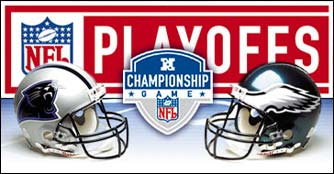
In 80 years of playing football, the Philadelphia Eagles have won only three league championships, all prior to 1960. They’ve been to just one Super Bowl, losing to the wild-card Oakland Raiders 27-10. Most recently, they’ve played in three consecutive NFC Championship games, losing each, and two at home, one each to the previously hapless and expansion Tampa Bay Buccaneers and Carolina Panthers.
Crashing the boards since 1967, the Philadelphia Flyers have engraved their names on Lord Stanely’s Cup only twice, in 1974 and 1975. In the 29 years since, they’ve played in the Stanley Cup Finals five times, losing each with a combined record of 20-6 and winning an average of just one game per series, and being swept 4-0 in their most recent appearance in 1997.
Finally, the Sixers. In their 41 year history in Philadelphia the 76ers have won world championships in 1967 and 1983. They have made four other trips, losing each time, most recently 1-4 in 2001.
This city has not had a parade down Broad Street in 21 years. That’s 84 combined seasons of play across the four major teams, and not one championship. In hushed tones, people here call it “The Curse”: that since city ordinances were changed to permit the building of structures higher than William Penn’s hat on City Hall, no major Philadelphia team has won its championship series. And when we’ve lost, we’ve lost in dramatic, bold fashion.
Because of this … because of our mad concoction of love of sport and dismal performance … we want the Triple Crown. We want it so bad we can feel it … hell, we NEED it.
Indeed, we want it so bad we’re afraid of it.
So around here today, Philadelphians everywhere are going about our preparations for The Big Race with an air of excitement, optimism, and hesitation. We’re asking ourselves questions like “Should I get a centerpiece for the table that has roses, black eyed susans and white carnations, or should I just get tulips?” Thinking, “Should I splurge for the short ribs, or should I just get beef ribs?” Wondering if we should buy the champagne.
Because we know: the more we want it, and the better our odds, the more likely we are to … well … we can’t say it. We just know it in our bones, where it aches like a cold, damp spring night.
That said, the necessity of being a Philadelphia sports fan is the necessity of optimism. We must find a reason to rise another day, regardless of the dampness of the night, and so we do. And out of this optimism, we dare to hope about Smarty Jones. In the end, we’ll buy all three flowers, the short ribs, and the champagne. Because today just might be the day … the day of our deliverance.
What’s more, there’s something a bit different about this latest opportunity for victory … something just a bit different about this horse, about this time, about this sport. He’s a tough horse. People say he looks at other horses like he knows he can kick their ass. He’s strong and fast and charismatic, and perhaps best of all for Philadelphia sports fans, who like their heroes bold but real, gritty but humble, Smarty simply wants to win. He simply wants to run, have fun in the dirt, and win. He’s an athlete as athletes once were, a hero we can admire once again.
So we feel today may just be a bit different … and as we talk about The Race with hesitation and trepidation, deep down inside there’s a small nugget of warm hope, an inkling of confidence that yes, by God, I think today’s going to be the day.
As Bill Lyon wrote today:
On Hempstead Pike, just down from the Triple Crown bar, just across from Gate 6 and the stable area entrance at Belmont Park, is a cubbyhole diner, and at the counter a man in faded jeans and white undershirt is bending over his eggs and potatoes and talking to himself.Suddenly, he rises off his stool and puts the first two fingers of each hand on top of his head in impersonation of a horse's ears. With his right arm and hand, he makes the motion of a jet plane taking off.
“Smarty Jones,” he croons.
He watches as the imaginary Smarty soars up and out, presumably disappearing from view. And he looks and he looks, as we do while watching a loved one leave, and then he whispers after it:
“Gone…”
Smarty Jones. The Curse. Whoosh … gone.
Sister describes last sighting of Laci Peterson.
My Response: WHO CARES!?!?!?!?!?!?!?! STOP BOTHERING ME WITH FRIVOLOUS NEWS!!!!!
Screw all official media. Read The Command Post.
Those interested in wikis might find this First Monday article of interest: Phantom authority, self–selective recruitment and retention of members in virtual communities: The case of Wikipedia by Andrea Ciffolilli. It offers an economic analysis of virtual community participation, using Wikipedia as a case. The abstract:
Virtual communities constitute a building block of the information society. These organizations appear capable to guarantee unique outcomes in voluntary association since they cancel physical distance and ease the process of searching for like–minded individuals.In particular, open source communities, devoted to the collective production of public goods, show efficiency properties far superior to the traditional institutional solutions to the public goods issue (e.g. property rights enforcement and secrecy).
This paper employs team and club good theory as well as transaction cost economics to analyse the Wikipedia online community, which is devoted to the creation of a free encyclopaedia. An interpretative framework explains the outstanding success of Wikipedia thanks to a novel solution to the problem of graffiti attacks — the submission of undesirable pieces of information. Indeed, Wiki technology reduces the transaction cost of erasing graffiti and therefore prevents attackers from posting unwanted contributions.
The issue of the sporadic intervention of the highest authority in the system is examined, and the relatively more frequent local interaction between users is emphasized.
The constellation of different motivations that participants may have is discussed, and the barriers–free recruitment process analysed.
A few suggestions, meant to encourage long term sustainability of knowledge assemblages, such as Wikipedia, are provided. Open issues and possible directions for future research are also discussed.
The bottom line: wikis grow because they're easy to use, and the quality stays high because it's easier to revert to a prior page than it is to mess one up, especially via online vandalism.
Is there a cheaper gas station just down the road? Probably … visit Gasbuddy.com, where people post the lowest gas prices in towns all across the US.
The Wall Street Journal's Opinion Journal has launched an online Electoral College vote calculator, which allows you to see electoral histories and the current landscape. And for the truly geeky: you can create and save scenarios, exploring how the election might unfold as the election polls to November. See the calculator and its backstory here.
Inspired by the original:
Within a commemorative area at the western side of the memorial is recognized the sacrifice of America's WWII generation and the contribution of our allies. A field of 4,000 sculpted gold stars on the Freedom Wall commemorate the more than 400,000 Americans who gave their lives. During WWII, the gold star was the symbol of family sacrifice.

You can view the original online here.
Fourscore and seven years ago our fathers brought forth on this continent a new nation, conceived in liberty and dedicated to the proposition that all men are created equal.Now we are engaged in a great civil war, testing whether that nation or any nation so conceived and so dedicated can long endure. We are met on a great battlefield of that war. We have come to dedicate a portion of it as a final resting place for those who died here that the nation might live. This we may, in all propriety do. But in a larger sense, we cannot dedicate, we cannot consecrate, we cannot hallow this ground. The brave men, living and dead who struggled here have hallowed it far above our poor power to add or detract. The world will little note nor long remember what we say here, but it can never forget what they did here.
It is rather for us the living, we here be dedicated to the great task remaining before us—that from these honored dead we take increased devotion to that cause for which they here gave the last full measure of devotion—that we here highly resolve that these dead shall not have died in vain, that this nation shall have a new birth of freedom, and that government of the people, by the people, for the people shall not perish from the earth.”
The Department of Veterans Affairs National Cemetery Administration maintains a web presence for our National Cemeteries, most of which are holding services this Memorial Day. Go here to visit the site, and here to read the list of Memorial Day ceremonies.
The World War II Memorial, which will be officially dedicated at 2 PM EDT today, has a presence on the World Wide Web. Visit it here.
I'm home for a spell, getting reacquainted with family, house, office and yard. It's been a long several weeks of travel, and I'm already enjoying the bay-window view from our home office more than I typically would, watching the robins chase baby grasshoppers through the grass.
I flew home yesterday morning from Dallas, and on the plane managed to read both the New York Times and Wall Street Journal. Somewhere in the middle of these two publications of record is the Middle Position, and I enjoy reading them back-to-back.
In Friday's journal was a piece by Daniel Henninger, author of the regular OpEd column Wonderland. As we begin this weekend of remembrance, it's something I wanted to share. Enjoy; hope it makes you think.
The Ultimate Sacrifice Asks for One DayCALVERTON, N.Y.—Here at Calverton National Cemetery, a place of sandy soil and quiet trees on eastern Long Island, workers are putting up American flags that will line the roads on this Memorial Day weekend. Boy Scouts and Girl Scouts will arrive tomorrow to place small flags on each of Calverton's 146,000 grave sites. This is Calverton's busiest weekend.
But on a rainy afternoon in midweek, Calverton was empty and calm. It was probably like this in all of the 120 national cemeteries around the United States, which hold the remains of American soldiers all the way back to the Civil War.
I saw an old man at Calverton park his pickup and head out with a bad limp across an expanse of white grave markers. He seemed to know where he was going. I stopped by two new graves, side by side, with very white headstones. They had fresh flowers and a votive candle still burning from morning visitors. Someone had left an unopened bottle of Bud beneath the flowers, meaning I guess that the soldier liked his beer.
Both of these men, Army Staff Sgt. Anthony S. Lagman and Sgt. Michael J. Esposito Jr., winners of the Bronze Star with valor, were killed the same day in Afghanistan in March. Sgt. Lagman's headstone says: “Persian Gulf, Bosnia, Afghanistan.” To the right of their graves lies Marine Lance Cpl. William Wayne White, who died last year, early in the Iraq war.
Most people don't seem to know there are more than 100 national cemeteries around the United States. Nearly every one will have public services this Memorial Day weekend. Most of the employees of the National Cemetery Administration, a relatively small agency, are themselves former veterans, who ensure that each of these beautifully landscaped and austere facilities is as impressive as the familiar photographs of Arlington Cemetery.
Memorial Day itself has been a holiday in decline from its original purpose, the honoring of the nation's war dead, an idea born in the internal sorrows of the Civil War. Memorial Day parades, though still held, are often not the bracing civic reminders they once were of the idea of national service. More recently, this day at the end of May has become a Monday off and a chance to prepare for summer.
The U.S. military itself contributed to the decline, concluding from the Vietnam experience that the draft was more trouble than it was worth. The military wanted men and women committed to service, not gripers coerced into it. It was popularly said that in place of a citizens' army we had created a professional army. That distinction is breaking down under the reality of war in Iraq and Afghanistan, and the deaths in service that have attended them. An old phrase, “the ultimate sacrifice,” is being heard again, and with it the idea of great honor for war's fallen fighters.
If you go to a national cemetery this Monday (the list is at www.cem.va.gov/index.htm), you will find people gathered for whom Memorial Day is as real now as it was in the 19th century. Last year at Calverton, some 2,000 people came for the ceremonies. The little, 0.3-acre cemetery at Danville, Ky., established in 1862, had 50 people. But 10,000 will likely come for the service in Riverside, Calif., 5,000 at Fort Custer cemetery in Michigan, 8,000 in Houston, 3,000 in Oregon, 1,500 at Fort Richardson, Alaska, and 2,300 in Puerto Rico.
There will be speeches, color guards, flyovers where possible and of course a bugler to play taps. Volunteer groups organize most of these ceremonies. Indeed at many of the cemeteries volunteers often provide the three-person color guard to which every veteran is now entitled at burial.
There are 16,897,000 living veterans, which makes for a very large band of brothers. At a big cemetery like Calverton on Long Island, they'll do 7,300 burials a year. Standing in this cemetery on a wet day, staring out at field after field of white gravestones in perfect rows, each marked with a name and a war, one frankly has the expectable, and welcome, feelings of gratitude and respect. Still, one can't help but feel overtaken by the awful, indiscreet largeness of war's claims on the living. Amid Calverton's stillness, the cemetery's director Rick Boyd offers without prompting: “Each one of these people had a particular service story, and I often wish I could know what they were.”
If you go to the Cypress Hills national cemetery in Brooklyn, you can see the grave of Sgt. John Martin, trumpeter, Seventh Cavalry, killed at the Battle of the Little Bighorn in 1876. He was born in Italy as Giovanni Martini. Yesterday coming to work past the September 11 World Trade site, I encountered about 200 very young Marines outside the fence, dressed in simple training fatigues—green T-shirts, pants and boots—standing in formation, at attention, stock still at an awards ceremony. We don't see this sort of thing in Manhattan very often, and when they marched off—their stern, impossibly youthful faces reflecting the modern American melting pot whence came Giovanni Martini, bugler—the commuting office workers began to applaud.
Much of the politicking around Iraq is rather nasty just now. And there will be more of it. For a minute this Memorial Day weekend, ponder the simple individual nobility held forever in those 120 national cemeteries.
Back home for a bit. Aruba was nice, but truth is that I spent all of some 30 minutes outside and engaged in typical Caribbean-type activity. Still, as I noted before, it beats Detroit.
This entry is more of a Public Service Announcement than anything else … on the flight home I had occasion to see Paycheck, with Ben Affleck and Uma Thurmond. It was, I am certain, the worst film I have ever seen.
Be warned.
Of course, it's SO bad that it qualifies as comic relief … for, perhaps, a Paycheck Party where everyone drinks each time there's a non-sequitur, an abjectly ridiculous use of technology, or trite utterance. You'll be drunk before the first twist in the tale.
Here's what some of the professional reviewers thought:
“The amazing thing about John Woo's steely, impersonal adaptation of this Philip K. Dick sci-fi story … is how it vanishes in front of our eyes even as we watch it.”“A story that doesn't make a lick of sense, even on its own coherence-mangling terms.”
“You've seen Roadrunner cartoons with more suspense than this entirely predictable hash.”
“This is cinematic cotton candy at its most caloric, and could pass as worthy yet inconsequential entertainment if it only had a tenth of a brain.”
And, of course:
“Desperdiça uma ótima idéia em prol da ação descerebrada.”
Aptly named, this film … the paycheck is the only thing that could have attracted someone of Uma's talents.
We're beginning to use wikis in our office. Like weblogs, they're a relatively new medium that, to the unexposed, at first elicit sort of a “huh … so, like, what is it again?” Well, if weblogs let you publish an online news source our journal, wikis let you publish an online reference document.
Like an encyclopedia, each page in a wiki is about a particular topic. But here's the catch: any user can edit that page over time, and you can link to other topics within each page. As a result, high levels of collaboration create references that evolve with time, increasing in relevance and currency as more and more people improve and edit the page.
Example: Imagine if your encyclopedia's entry on NASA, rather than being written and edited by one or two people who were only marginal subject matter experts, was instead constantly being edited by hundreds of people who were all subject matter experts. And imagine if you could instantly link to other entries on topics mentioned in the NASA entry (like “Mars Odyssey” or “Russian Aviation and Space Agency”). You'd end up with an awfully robust NASA entry.
And that's how the largest wiki in the world is used: Wikipedia. Here's the NASA entry, and if you think it needs something that you can contribute, feel free to edit it … anyone can. Compare its free, layman-produced content to that of World Book, and draw your conclusions … oh, wait! That's right! You can't … because World Book requires a fee to use their encyclopedia. Ok then, compare it to the Encarta entry, and draw your own conclusions. And to learn even more about wikis, visit the Wikipedia entry for wiki.
Today from from Bill Lyon:
Horse people unfailingly remark of Smarty: “He just looks like he knows he can kick your ass.”
I just returned from a few days in Chicago and Minneapolis. The airports were packed … especially for a Wednesday afternoon. Say what you will about the economy: by my experience the world is taking summer vacation, and it’s not waiting until Memorial Day.
As I pushed through the crowds with my rollaboard, I kept chewing on my Iran post of earlier today. When it’s all said and done, the questions we’re asking about Iran and its proliferation doesn’t seem to be the correct question. As it’s being framed publicly now, the question is: “Do we want a fundamentalist Islamic state to control nuclear weapons.”
And the answer to that, everywhere expect Iran, is “No.” Too destabilizing … too much opportunity for WMD to reach a terrorist network … too much of a catalyst for continued proliferation of nuclear technology through that part of the world. And we use the threat of Iran joining The Club as one (of many) reasons to drive toward regime change there.
But if you take Nick Kristof at his word, it’s not just the Mullahs that want Iran to have nuclear capability—it’s the Iranians themselves. So the question I keep coming back to is: “Why would that change with a change in regime?” I can’t see how it would, unless we were to extract concessions from the new regime that they wouldn’t stride further down the atomic path. And frankly, even if they did, how realistic is it to expect they’d honor that commitment … joining The Club is the single greatest symbol of having arrived on the global political-economic stage, and it comes with all sorts of trappings and honorifics. That’s why they call it a “club.”
If anything, we should expect a liberal, democratic Iranian regime to be even more strident about proliferation because they could call our bluff on any barrier we might construct to their entry: what are we going to do, bomb the power facilities of a peaceful, liberal democratic trading partner? Look to history: What do the members of the Nuclear Club do when other economically and (generally) politically liberal nations develop nuclear weapons? If we take Pakistan, India, and yes, Israel, as precedent, the answer is: “Nothing.”
I raise all this because it seems to me that the members of the Nuclear Club have no real answer to the question of proliferation among non-totalitarian states other than the good assurances of the NNPT. If anything, the North Koreas and Irans make it easy for us … as rouge nations, it’s easy to respond to proliferation with force, bombing their capability back into the last century. But a connected, liberal North Korea or Iran (or Syria, or Brazil) with nukes … that’s a different story.
And is the world any more secure? Using my prior criteria: Too destabilizing … likely. Too much opportunity for WMD to reach a terrorist network … possibly. Too much of a catalyst for continued proliferation of nuclear technology through that part of the world … likely as well. Take the case of nuclear oversight in Russia (please) as an example, and see if you sleep any better.
All told, in the long run the prospect for proliferation among “friendly” nations doesn’t make me feel much more secure that it does among “unfriendly” states, and for the former, I believe we have no response at all. And perhaps, in the end, it doesn’t matter. There are plenty of liberal democratic states with nukes now, and as much as the Brits may want to bomb the French (and vice-versa), no one’s pushed the button as yet. It may be that between the promise of MAD and economic interdependence, nuclear weapons among an increasing number of liberal states is no big deal … except, of course, for the increased likelihood of WMD-related destabilization, terrorism, and proliferation that comes with each additional member of the clique.
I’d be interested in Tom Barnett’s take on this (hey, there it is), as well as anyone else with a two-bit opinion (same price as mine).
Villanova and Penn. Two Philadelphia-area private, elite, Big 5 rival schools.
How do you think that affects recruitment?
Mother Jones asks, “Stories make the world go around. So how come liberals can’t tell one?” Well, that's a bit strong. But consider this:
It’s plain why this [the Bush] story works as well as it does. It presents a classic hero and a journey that reaches down through the brain into the gut. And Republicans can translate it into simple, clear lines of action: Wage war and don’t stop. Cut taxes. Put bad guys in jail, or to death.Many on the left harbor the delusion that Republicans can be dislodged by criticism of this story. There are two main styles of critique. The first is ironic and humorous (see Al Franken). The second style is serious and raging, bordering on caustic (see Tim Robbins' “Embedded.”)
But, by definition, critics are at the margins. However loud they shout from the sidelines, they’ll never get in the game. The game is for those who can tell a story.
Rush Limbaugh knows this. He’s no critic. Sure, he rips into Democrats and liberals, but his point is always to describe the enemy — cowardly and pessimistic — in order clarify the attributes of his hero — courageous and optimistic. Every anecdote, every opinion, feeds into his story. That’s why he convinces so many people and that’s why he makes so much money. And that’s why he has helped engineer a profound change in the culture of the country’s government.
On the other hand, the advent of “Air America” illustrates the left’s deluded love affair with criticism. The debut ad campaign features photographs of right-wing bugaboos, with smart-ass lines plastered over their faces (“We Pump Irony” over Schwarzenegger and “All the Caffeine and None of the Oxycontin” over Limbaugh). These are clever, but 100% content-free. The most revealing of the ads is a picture of Ralph Nader. “Mocking the Far Right and When We’re Tired of that The Far Left.”
The network is all criticism, all the time. Franken’s show is hilarious and brilliant. But it’s one thing to convince me that the right is full of big fat idiot liars. It’s quite another task to articulate the character of a movement, which can show itself in times of opposition, and in times of leadership.
The essence of the narrative form: setting, sympathetic hero, unsympathetic antagonist, conflict, resolution (one in which, typically, the hero changes in a fundamental way). You’ll notice that critique is not mentioned … and when you’re criticizing the other guy’s story, you’re not telling your own.
Take this quiz from the Citizens for Independent Public Broadcasting and find out. I'll help you get started:
6. How many hours per year does the average American youth spend watching TV?ANSWER: d. 1,023 hours. Compiled by TV-Turnoff Network for New York Times Magazine, February, 16 2003.
7. How many hours per year does the average American youth spend in school?
ANSWER: d. 900 hours. Compiled by TV-Turnoff Network for New York Times Magazine, February, 16 2003.
I also recently heard that in coming years the average American, by the time of his or her death, will have spent nearly 11 years of their life watching television.
Now … if you got to death's door and were offered another 11 years, (1) would you take it, and (2) would you spend it watching reruns of West Wing? That's what I thought …
You have likely not heard of Tom Barnett. He is a professor of warfare analysis at the Naval War College and a Defense Department analyst. He’s also the man who in 1998 worked with senior executives at Cantor Fitzgerald to study how globalization was changing national security. More recently, though, he’s been briefing the Office of the Secretary of Defense, Pentagon staffers, and the intelligence community his view of the future of US national security and the military it will require, and he appears to be shaping their thinking.
His central tenet is that the world is divided into nation states that are either part of a global community linked by trade, migration and capital flows, or nation states that either refuse to join the mainstream, or can’t because they have no central government or are debilitated by crisis. And for us, Community:Good, Non-Community:Bad (as in the breeding ground of terrorism, disease, and economic imbalance).
Given such a world, Mr. Barnett believes the US military should include two forces: “Leviathan,” which would be a hard-hitting force capable of quickly overwhelming conventional foes, and “System Administrators,” which would focus on bringing dysfunctional states into the mainstream through nation-building operations, and which would travel the world during peacetime building local security forces and infrastructure.
His thoughts, currently captured in a 3-hour PowerPoint presentation he’s developed, are perking ears in the military, intelligence, and government community. He’s delivered the presentation more than 150 times, and recently to the Pentagon's Joint Chiefs of Staff. His is an interesting and important argument … the most readily available account of which is this article he wrote for Esquire in March, 2003. You can get a more recent take in this WSJ article, reprinted on Dr. Barnett's website.
And finally, if you really want a glimpse of the man behind Leviathan, you should visit his weblog. A recent post: The New Core pillars at risk (India). (What, you're not surprised he's a blogger, are you?)
John Sack, legendary war correspondent for Esquire Magazine, has died. Esquire has his most acclaimed work, the 33,000-word October, 1966 Vietnam dispatch M Company, from Fort Dix, New Jersey to South Vietnam, online and free for your reading. It is, especially now, a fascinating work of journalism.
MONDAY MORNING for thirty gay minutes, for the first time in its corporate history, M could experience pleasant weather. The temperature at M's altitude was 70, and through the sides of its swift helicopters there came one of those summer-in-a-sports-car and hair-rumpling breezes. With its whole silent battalion and three battalions more, M was in combat clothes and being lifted out toward the Michelin rubber plantation, a forest where the communists, all busy little beavers, had been whittling bamboo stakes for several days, dipping them in buffalo dung, urinating on them, putting them in punji pits, in foot-traps, in mad little Batman traps in trees, whiz! out of bushes, pop! out of ferns—aargh! and burying mines, and hiding grenades, and step on the wires and “Look out!” grinning old Foley had told M back in its infantry training, two weeks earlier, “Look out! here it comes! five whole gallons of flaming gasoline!” Through some diabolical means, the communists at the Michelin plantation had learned of the Operation the week before, although it was classified SECRET.
Take the time and read the rest.
He rumbled down the stretch like rolling thunder, running on air and running all alone, the others already having abjectly surrendered, thoroughly cowed by this mighty machine, and the only remaining question was how much would he win by.
The city is crazed for this horse. Read the rest of the local Philadelphia take on the city's most recent hero, from Bill Lyon.
I did. The old Avocare design just wasn’t working for me anymore, and the Photoblog (the most recent post of which, incidentally, is over in the right-hand column) is the outlet for most of my touchy-feely creative energy these days, and the Avocare travelblog idiom wasn’t working for me either. So I’ve made a change in design, which, I expect, will be accompanied by a change in posting philosophy.
We are, after all, our context. So we’ll see what happens.
This look also includes some fancy behind-the-scenes coding tricks that most of you would never see but of which I’m quite proud, one of which is getting the post title and post entry to be on the same line. If you’re curious as to how I pulled that one off, send me a note.
I also know some aren’t fond of the orange-blue combo look. I’ve always liked it … a bit non-traditional, it works artistically, and it’s been very good to some. The great thing about CSS is that I can change it on a whim (and I just might).
So I hope you like it … and I expect that in a year or so, I’ll change it again.
Fern.
Also, I've entered Mist in the Photo Friday contest. Visit Photo Friday and see all the pretty pictures, and while you're there, cast a vote for my submission (you'll see the name “Avocare” in the left-hand column, entry #301).
She can't win! Now this is on the way … streaming across the global network, destination determined and effect certain!
Y o u c a n ' t s t o p m e . . . y o u c a n o n l y h o p e t o c o n t a i n m e!
(And frankly, tonight … she's not even gonna do that.)
Thank God she stopped blogging …
;-)
… and that means I'm gonna torture Michele.
How? With music, of course … and as a first salvo, I've just fired this via email.
Enjoy. I f y o u c a n.
Michele alerts us that Stacy (who did the layout design for Command Post) is moblogging a Buffet shot at this very moment. Go here to see her pics; even better, go here and listen to the show live.
Who … I say, WHO … ever said that dag-blammed Internet was a waste of time, huh? WHO?!?
Not anyone who's every viewed Red v. Blue, that's for damn sure. (And if you don't have broadband, well … get it, yo.)
 Went out to the car this morning, read the thermometer and it read … uhhh … 28 degrees? Really??
Yes, really.
Hmmm … coulda' sworn spring was around here somewhere. Oh yeah, there it is.
So without Spring out there, I brought it in here … so check out Tulips, on the Photoblog.
With an entry worthy of this page: Peep Jousting.
Anyhow, if you place Peeps in a microwave and set it for one or two minutes, they'll swell up. Actually, any generic marshmallow will do this, but it's much more fun if they're chicken-shaped. To have a Peep Joust, simply stick a toothpick in two Peeps, place them facing each other in a microwave, and fire that sucker up. Soon enough, the two Peeps will swell and one will stab the other one with its toothpick jousting lance. Sounds fun, doesn't it?
Why yes … yes it does. And thusly, a new Easter tradition is born …
I'm in Philly for the next week or so … part of a general effort to spend a week in the office every four months in 2004. It should give me the chance to catch up on necessary things … wife, health, house … as well as Avocare and the new Avocare Photoblog.
And regarding blogs, it's been a year since Michele and I created Command Post … seems difficult to believe it's been only a year, as TCP is such a part of the daily fabric now. I'll reminisce over there, where we've been posting remembrances from around the world throughout the weekend. No cake, but fun overall, and worth a visit.
This is the “About” entry for the photoblog:
Ahhh, the Utes lose in the first round. So it goes.
Not much posting lately, I know. Perhaps this will help.
Damn Michele. In her TCP Op Ed on Spain she sends me here. And then I remember the Changing of the Guard, which leads me to this site and video stream of that incredible moment. And I can't help but have tears in my eyes, and struggle not to cry.
So I suppose I'm not over it yet. Maybe because I fly too much. Maybe because I was on an airplane that morning. Maybe because I lost someone I respected. Maybe because I just kept working that week. Maybe because I love Wife more than anything else in my life.
And all that is so much less than those who were there, and those who lost ones they loved.
But I still think of it often. It still colors my view of each day. I still leave home each day, reminded of the impermanence of life, knowing it may be for the last time, and reminding myself to be at peace as I blow a kiss to the house over my left shoulder.
So I made this today. I started with the actual proportions — 1×6.8 — but the final result is taller than that. There are just too many names.
I may never get completely over it. But I will never forget.
 Muon, the Muon's connected to the … Positron.
The Avocare naturalist posts continue. Want to see computer graphic images of subatomic particles colliding into a nickel plate at the speed of light? Visit Fermilab Now. Scientists exploring the ends of time, updated in real time.
Usually I think Bill Maher is a whiney, grumpy, angry old fart who gives those folks from the left who have good names bad names. But this week's “New Rules” are priceless, and you should read them here.
All right. New Rule: If everybody was wrong about the weapons of mass destruction, then somebody has to say, “My bad.” When Bill Clinton was in the White House, we investigated his business partners, his wife's business partners, the guy who was governor after him, the girls who did him, his travel agents and the guy who cut his hair. For some reason, the two words this president just can't seem to say are “Sorry” and “nuclear.”Something is terribly wrong when the only person who has been fired over terrorism is me.
If you listened to the link in the prior post, you may like to know that the oral history project in which that couple took part is part of StoryCorps. Go here to listen to stories from StoryCorps, or to record an oral history of your own.
Forget all the longing, poetry, gifts, flowers, and songs of love. To feel all the Valentine’s Day emotion there is to feel, simply listen to this.
Yes, it’s real. Here's the brief set up: a couple, he 25 and she 26, in an Oral History Recording booth in New York City's Grand Central Station. Listen to get the rest, and you may go here to learn the rest of the back-story.
And if your eyes are dry at the end … then you, sir, may well have no soul.
My wife.
I love you, sweetie. Thanks for making each day so full of love and fun that our Saturdays tend to feel like Valentine's Day, and our Valentine's Days tend to feel like Saturdays. You make me a better man, and I love you.
Yet another in my series of cloud shots, this taken somewhere over western Pennsylvania. Click to see full-sized.

Catching some well-deserved shit for not posting lately. Funny thing is that there's actually more than a peck to post … I've simply been very busy, and directing most of the blog energy I do have to TCP.
That said, I saw this report on CNN today, and found the sites it mentions fascinating. Consider this the latest in the Avocare series of naturalist posts. Read the CNN article if you wish, but to cut to the chase go here and be amazed:
That's the amazing thing about the Web: I can say to Wife, “Give me a word. Any word.” She says, “Tree.” I type “tree” into Google, and find the Tree Of Life Web Project. Go to the Life On Earth page first. Follow the links and you will be there for at least 30 minutes. Do this with a child, and you may be there for hours.
 Today, we remember some of the world's many heros:
Read the NASA memorial page here, or, read what I think may be the single best piece written about Columbia, Bill Whittle's Courage, here.
Sensors fail all the time. But this was different. This was a pattern, and it was spreading. And something was starting to pull the ship to the left.I don’t know the words he used, but I can hear the tone perfectly in my head, because it’s exactly the same tone I’ve heard dozens of times on cockpit voice recorders. It’s concern. Alarm, even. But it’s cool. Disciplined.
All right, we’ve got a problem here…
The Pilot and Mission Commander probably never exchanged the knowing look that we’d see in the movie. They were too busy working the problem. But in the two seats behind them, and the three below, those five brave passengers looked at each other and now the smiles and the grins were gone.
Something was wrong with Columbia’s left wing. The air that should be slipping over and under her like water off the back of a duck had found something to hold on to: perhaps some missing tiles, perhaps a dent, or a micrometeorite hit – we just don’t know. But 3000 degree ionized air was pushing into that wing, and heat sensors were winking out one by one because they were being burned through by gas far hotter and sharper than that at the end of a blowtorch.
Guys, we’re in real trouble here.
The Commander would have told them. I have no doubt of this at all. You love and respect those people, people who have shown courage the likes of which we will never know. These are not babies, not shrieking, hysterical, self-centered adults either. These are astronauts. They deserve to know.
The air pushing backward and into that left wing continued to yaw the nose of the orbiter to the left. This cannot be allowed to happen – the ship will disintegrate if she doesn’t come in at exactly the right angle. So the computers flying Columbia commanded the aircraft to roll right, to bring that left wing forward using the rudder and elevons, the controls on the wing and tail that made Columbia an airplane and not merely a space capsule.
It wasn’t working. Columbia still pulled hard to the left, so hard that the computers fired the attitude control rockets on the nose to try and force it back into the relative wind. When that happened, when they heard the roar of those rockets firing in a last desperate effort to keep that ship intact, and when the rockets fired again, and kept firing, Rick Husband and Willie McCool must have known that they were not going home that day.
Guys, it’s Rick. I don’t think we’re gonna make it.
And I know what courage did for these people. I know they looked at each other and nodded, and whether they actually said goodbye I know it was in their eyes. We know it. We know. We saw it on the deck of the Titanic, in the aisles on United Flight 93. On some level, they had all said goodbye to their families and their lives before they walked through that circular hatch, right below the word COLUMBIA.
When PSA Flight 182 collided with a small plane over San Diego in 1978, and dove straight into the ground trailing fire from the wing, the last words on the Cockpit Voice Recorder was a calm, level, “Ma, I love you.”
And in that last second, there may just have been enough time, as that bulkhead wall opened into golden and purple light, to smile and think, It was worth it. It was a great ride. I wouldn’t have traded this for the m
Buildings shook in Texas. Columbia was coming home.
(This post is cross-posted here.)
 Some things are quintessentially Philadelphian. The Eagles reaching the NFC Championship game three years running and never breaking through is a perfect example: lots of energy, lots of hope, just a taste of insecurity, and in the end, no prize.
Maybe it’s because the city sits between the glamour of New York and the power of Washington … maybe it’s because Philly is, in its soul, still a blue collar labor town … but the vibe here is still very much the vibe of the “cutters” … the kids in Breaking Away who never went to college, instead working in the local quarry or mill, and who look at their college-attending peers with a mix of longing and disgust.
The cutters make up for their edge of insecurity, of course … by living larger than the college kids could hope to live. And so do people here. How else do you explain something like the Mummers? And in that spirit, yesterday Philadelphia enjoyed an event which I consider the most Philadelphian of Philadelphia stories: Wing Bowl XII — 24,000 Philadelpians crowding the Wachovia Center to watch the Buffalo Wing eating competition to end all Buffalo Wing eating competitions. We don't got no Super Bowl, but by God, we got this. Read about it here, and here, and here, or watch video here, and be properly amazed.
Yeah … I know I've not posted in a week (here … posts galore over at CP). But the pain of the Eagles crash-landing took my spirit for a few days, and then I was in Chicago, and then … well, nevermind.
So go ahead Michele, torture me all you want. It's putting up with your emails that gives me superior Karma, which presents itself as consistently amazing parking luck.
I do have some goodies from the game, though, and will post them here directly.
Further, the officers noted that “Salamone’s pants were unbuttoned and unzipped.”
I'm just sayin'.
Yes, we're still here … wrapped warmly in our little home as the icy Pennsylvania winter tries to seep in under the door and windowsills. Tonight ours is a house divided … with Wife wearing her cheesehead and I my wings. The next two hours will mean much for the next week.
Here's something you probably don't think of checking every day, as you consider the sky outside your home on your way to work: the weather report for our buggy on Mars. Curious? Check the local Mars weather here.
Those who know Wife and me know we … well … we drink beer. We drink A LOT of beer. That said: Go buy a case of Dogfish Head beer. Get the Tackle Box sampler. You won't regret it. I've nuzzled up to bottle of the Raison D'Etre to accompany the AFC Wildcard, and damn. (Does the 8% ABV help? Probably.)
I won't bother with all the “hint of earthiness” and “taste of hoppiness” BS. Just go buy some. Four out of four empties.
Good question … at home, which is a nice change of pace for the usual regimen of travel. Watching football … spending lots of time in front of the PS2, hanging with Tiger and Psymon and Donovan, and with hockey-crazed Wife, Scotty … it all, it’s been a wonderful week.
I have been blogging, mind you, but have spent nearly all of that time at Command Post, tracking the air security threat in particular. So if you just can’t live without my scintillating prose, go there.
I have not been on an airplane in 16 days, and frankly, it’s been wonderful. That said, I’m feeling ready to get in the saddle again … and a sure as the sun will rise, I will be in Chicago next week.
But tonight, we continue the party. Hope you do, too.
It begins New Year’s Eve. Other families go out, don their best, engage in New Year’s revelry at fancy parties with buffets and crab legs and fireworks and open bars. We do that here, at home. It begins with PS2 games around noon, and extends into the late New Year’s Eve bowl games in the afternoon and evening … games which, today, include my alma mater playing in the Liberty Bowl. Courses flow from the kitchen throughout, with Wife’s pigs-in-blankets being a highlight for the Utah game, with shrimp and filets to follow later in the evening, with beer, cigars, and later, the after-dinner drinks, all flowing with total disregard for personal health or well-being.
It will continue tomorrow with Slug Fest Proper, a state of mind more than anything else, in which we and all guests commit to a “fleece only” dress code and food and football throughout the day. We’ll start the New Year with mimosas, of course, and will switch quickly to other libations as the bowl games roll past.
Oh, and we gamble. As much as possible. At this moment, Wife, colleague JD, and I have bets going 11 different ways on the bowls … losers lose, the winner wins, and second place … that’s just another name for first loser.
While on the subject of the bowls, each year some parties have interest in my selections, which have, throughout the years, seemed to be money in the bank on more occasions than not. So here they are … and no promises that this year, the first with a public declaration, won’t also be the first where I puke all over myself and go 0 for 15.
Auburn -3Minnesota -4
Utah -2
Missouri +2½
Colorado State -1
Iowa +3½
Maryland –3½
Georgia -3
So. Cal. –6½
Miami +1½
Oklahoma St. +2
Clemson +5
OSU +7
Tulsa +7½
LSU + 6½
That’s what the fates have: A SICK sense of humor. Poor Wife recovers from strep throat just in time for Christmas, and then comes down with a vicious attack of acute viral gastroenteritis, likely caused by this sick bastard, at last night’s Devils / Islanders game.
For the record: It’s cool to be led around in the bowels of Continental Arena, seeing where the players’ wives hang out, the medical area, the place the players dine before a game. It’s not cool for the reason for your tour to be an usher pulling you aside: “Sir … are you with the girl in the Devils jersey? She’s being taken to our medical unit …”
And so our weekend is one of care and illness. We’re to take vacation on Tuesday … she should recover fully by then, and with any luck, I won’t catch the damn thing myself.
I’ve propped her up enough to control the TiVo remote, and she’ll likely be asking for the iBook before long. If she does, she’ll check in here. So wish her well in the comments, will ya? She could use a smile.
 Hey … you: Stop a moment. Pause for just a second, and think of your holiday plans.
Planning something good?
Think of the family and friends around you.
Think of the hot meal you plan to eat tonight.
Think of the wine you will drink.
Think of the soft bed you’ll enjoy.
For many of you, think of how you will rise tomorrow and enjoy the celebration of gifts and joy, swaddled in pajamas, perhaps sitting by the fire, perhaps, if you’re like us, with a morning toddy to relax the holiday spirit.
Tomorrow, many of the people who rush into the breech to defend that way of life will enjoy none of those things. They will rise in a foreign land and foreign culture, far from family and friends, fresh from a military issue cot or bed roll, their last meal an MRE, their last drink from a canteen, and they will lower their helmet, raise their firearm to their shoulder, and begin the lookout for trouble.
Tomorrow, it does not much matter if you believe they should be there or be here. What matters is that they know you care. Click this link, send a soldier an email, and let them know someone is thinking of them, cares, and is thankful.
Having resurfaced from the end-of-year crunch, I note that my brother is a year older today. I think he always felt a little screwed, having a birthday on Christmas Eve. From my 10-years-younger perspective, though, I always thought was extra cool … imagine having your birthday surrounded by family, food, and frivolity WELL above and beyond that of the average celebration. So JR, what you saw as a liability, I saw as an asset.
So is the way of the world.
Regardless of perspectives, if you’re a reader who knows my brother (and yes … the biblical sense counts), wish him well in the comments. We won’t speak to how old he is, but know that however old that might be, he skis and lives with the vigor of men many years his junior.
Happy birthday, bro!
Regression to the Mean and Football Wagers, by Marcus Lee and Gary Smith, Department of Economics, Pomona College.
Consider these words from Army-Navy Game Tradition:
One of the most poignant moments in every game occurs after the final whistle when the two teams and the thousands of midshipmen and cadets in the stands stand at attention while the alma mater of each school is played by their respective bands. Win or lose, during those few moments players and students from both schools stand at attention in total respect for each other.Many who are annual attendees declare that it is the most emotional moment of the day and one they would never miss. For those few moments, the final score is put aside and the camaraderie that connects the men and women in the blue coats and the gray coats is transcendent. It is something that lives forever.
Wife and I just watched this moment ourselves, and each year, we sit in silence as both teams exhibit true honor, class, and sportsmanship.
Compare it to these words from CBS SportsLine:
Normally, Florida and Florida State get the fight out of the way beforehand. Not this time.Fights are nothing new in this bitter Sunshine State rivalry, but this one was different, in that it came after the game, not before. And it took police with pepper spray, not a bunch of coaches, to break it up.
No. 9 Florida State's 38-34 win over No. 11 Florida on Saturday was an emotional one, and when the Gators saw the Seminoles stomping on their `F' at midfield to celebrate, they took offense. Nor were they thrilled to see FSU players doing the Gator Chomp with a real gator jaw …
… In 1998, five players were ejected before the start of the game in Tallahassee including Florida's starting cornerback Tony George. During that dustup, Florida quarterback Doug Johnson fired a football toward Bowden, but missed.
The year before, they came close to a pregame fight, but a full-fledged rumble was avoided when officials steered riled-up players to their benches.
I could give a damn about his 340+ wins. What, exactly, is it that Bobby Bowden has to be proud of? Certainly not his graduation rate, which has averaged 53% since 1993 (and which was 40 percent in 1994). In the interest of fairness: I was unable to find grad rates for my Utes, but I can point to this with pride.
(Oh … and say what you will about Notre Dame, but know that they graduate 81%.)
Want proof? Download this video (note: it’s about a 4 meg file). For those who live in a low-bandwidth world, enjoy this view of Dog in the backyard, taken just moments ago.

The work of the day here is done … Wife and I returned from our Annual Christmas Tree hunt with a beautiful fir, have moved to hot rum cider toddies as pre-decoration libation, and are enjoying the splendor and tradition of Army / Navy.
Life is good. As my father would say, “Grab life by the throat and shake the shit out of it.”
Yep. The man’s a sage.
Found this while poking around on Snopes:
Claim: Recent unusual geothermic and seismic activity in Yellowstone Park foretells a coming cataclysmic event in the area.Status: Undetermined.
Seems there's nothing to worry about, but the full story is fascinating … read it here.
 … but my snow blower works just fine, thank you. And it’s a good thing, too, given the foot of snow on the ground. Last night was warm and cozy, and I even recorded this in hopes of starting a Friday Night Dance Party for Michele, but alas, dinner and DirecTV Pay-per-view interfered. This was much more true to the mood.
 And this morning, after we rose to meet the new snow on the ground, I rose the ladder to clear the gutters and sweep snow from the roof so as not to have a repeat of last year's Ice Dam Fiasco. Dog, of course, thought the whole thing was fantastic, and in fact, she’s right. It’s beautiful here, and we’re comfortably ensconced in our cozy house, TiVo and PlayStation2 close at hand, and beer and Baileys to warm our middles.
We’re having a great day here, and hope you’re having one wherever you might be.
If you can figure out what this is about, please let me know.
Oh … and it's snowing like hell in Philadelphia. Lots of warm fires and hot toddies for Wife and me tonight, you can be sure …
Of course, no discussion of 1980’s Buck Rogers can go far before it turns inevitably to its far superior cousin, Battlestar Galactica. So here, reminisce some more. Oh, if you’ve longed for a fix, how about the soon-to-be released PS2 game, or even better, the Sci Fi channel series, which begins December 8th. From the site:
So we've set out to bring the old boy back to life and give him a new look and a new outlook on life. And we're going to ask him to tell his stories again, from the beginning. Tell them again, but this time go deeper. See, we were young once and when the old guy spun his tales of Apollo and Starbuck, we were satisfied with clear-cut heroes and nakedly evil villains. But we're older now. We've eaten a lot of popcorn over the years. We're ready for a bigger meal.
Sure, I’ll watch … but will they have a Sarah cameo?
Oh … and did you know Battlestar Galactica reflects Mormon doctrine? No? Read here, or here, or visit GalacticaBlog (really!) and judge for yourself.
Wife and I were just noticing how the theme song for Bernie Mac sounds just like the music they’d play during dance sequences in Buck Rogers. You know, when Buck and Erin Grey would dance on a very 70’s disco-style light-up dance floor, with that little robot, who’d say tongue-in-cheek things like “Get down, Buck!”
Yeah, that music.
Anyway, that led us to talking about Hawk, and how coincidental it was that he happened to fly a spaceship shaped just like a hawk, and how Erin in her tight body suit and short skirt played a significant role in my growth to manhood, and what a terrible good crazy stupid show the whole thing was.
Just thought you might want to reminisce.
An extremely informative site well worth repeated visits: Fundrace 2004. The Candidate Rankings page graphically illustrates how the candidates compare along three indices, “GrassRoots,” “Devotion,” and “FatCats.” The MoneyMaps page graphically illustrates contribution patterns and levels on a map of the United States, instantly clarifying areas of contributory strength. Plan to spend at least 15 minutes. (Found via Politics1; cross-posted here.)
Update: And while your there, visit the sister site, GoogleRace.com … hey, Al Sharpton wins the “Penis” award!
Each year since 1961 the Wall Street Journal has published the same two editorial pieces the day before Thanksgiving. Titled The Desolate Wilderness and The Fair Land, they describe the great courage of our continent’s Pilgrims, and the great bounty they ultimately created in form of our free society. Reading them each year has been and Thanksgiving tradition for me and countless millions, and I now extend that tradition to you (in the extended entry below), in thanks for your visiting this page.
Enjoy.
The Desolate WildernessHere beginneth the chronicle of those memorable circumstances of the year 1620, as recorded by Nathaniel Morton, keeper of the records of Plymouth Colony, based on the account of William Bradford, sometime governor thereof:
So they left that goodly and pleasant city of Leyden, which had been their resting-place for above eleven years, but they knew that they were pilgrims and strangers here below, and looked not much on these things, but lifted up their eyes to Heaven, their dearest country, where God hath prepared for them a city (Heb. XI, 16), and therein quieted their spirits.
When they came to Delfs-Haven they found the ship and all things ready, and such of their friends as could not come with them followed after them, and sundry came from Amsterdam to see them shipt, and to take their leaves of them. One night was spent with little sleep with the most, but with friendly entertainment and Christian discourse, and other real expressions of true Christian love.
The next day they went on board, and their friends with them, where truly doleful was the sight of that sad and mournful parting, to hear what sighs and sobs and prayers did sound amongst them; what tears did gush from every eye, and pithy speeches pierced each other's heart, that sundry of the Dutch strangers that stood on the Key as spectators could not refrain from tears. But the tide (which stays for no man) calling them away, that were thus loath to depart, their Reverend Pastor, falling down on his knees, and they all with him, with watery cheeks commended them with the most fervent prayers unto the Lord and His blessing; and then with mutual embraces and many tears they took their leaves one of another, which proved to be the last leave to many of them.
Being now passed the vast ocean, and a sea of troubles before them in expectations, they had now no friends to welcome them, no inns to entertain or refresh them, no houses, or much less towns, to repair unto to seek for succour; and for the season it was winter, and they that know the winters of the country know them to be sharp and violent, subject to cruel and fierce storms, dangerous to travel to known places, much more to search unknown coasts.
Besides, what could they see but a hideous and desolate wilderness, full of wilde beasts and wilde men? and what multitudes of them there were, they then knew not: for which way soever they turned their eyes (save upward to Heaven) they could have but little solace or content in respect of any outward object; for summer being ended, all things stand in appearance with a weatherbeaten face, and the whole country, full of woods and thickets, represented a wild and savage hew.
If they looked behind them, there was a mighty ocean which they had passed, and was now as a main bar or gulph to separate them from all the civil parts of the world.
And the Fair Land
Any one whose labors take him into the far reaches of the country, as ours lately have done, is bound to mark how the years have made the land grow fruitful.
This is indeed a big country, a rich country, in a way no array of figures can measure and so in a way past belief of those who have not seen it. Even those who journey through its Northeastern complex, into the Southern lands, across the central plains and to its Western slopes can only glimpse a measure of the bounty of America.
And a traveler cannot but be struck on his journey by the thought that this country, one day, can be even greater. America, though many know it not, is one of the great underdeveloped countries of the world; what it reaches for exceeds by far what it has grasped.
So the visitor returns thankful for much of what he has seen, and, in spite of everything, an optimist about what his country might be. Yet the visitor, if he is to make an honest report, must also note the air of unease that hangs everywhere.
For the traveler, as travelers have been always, is as much questioned as questioning. And for all the abundance he sees, he finds the questions put to him ask where men may repair for succor from the troubles that beset them.
His countrymen cannot forget the savage face of war. Too often they have been asked to fight in strange and distant places, for no clear purpose they could see and for no accomplishment they can measure. Their spirits are not quieted by the thought that the good and pleasant bounty that surrounds them can be destroyed in an instant by a single bomb. Yet they find no escape, for their survival and comfort now depend on unpredictable strangers in far-off corners of the globe.
How can they turn from melancholy when at home they see young arrayed against old, black against white, neighbor against neighbor, so that they stand in peril of social discord. Or not despair when they see that the cities and countryside are in need of repair, yet find themselves threatened by scarcities of the resources that sustain their way of life. Or when, in the face of these challenges, they turn for leadership to men in high places — only to find those men as frail as any others.
So sometimes the traveler is asked whence will come their succor. What is to preserve their abundance, or even their civility? How can they pass on to their children a nation as strong and free as the one they inherited from their forefathers? How is their country to endure these cruel storms that beset it from without and from within?
Of course the stranger cannot quiet their spirits. For it is true that everywhere men turn their eyes today much of the world has a truly wild and savage hue. No man, if he be truthful, can say that the specter of war is banished. Nor can he say that when men or communities are put upon their own resources they are sure of solace; nor be sure that men of diverse kinds and diverse views can live peaceably together in a time of troubles.
But we can all remind ourselves that the richness of this country was not born in the resources of the earth, though they be plentiful, but in the men that took its measure. For that reminder is everywhere — in the cities, towns, farms, roads, factories, homes, hospitals, schools that spread everywhere over that wilderness.
We can remind ourselves that for all our social discord we yet remain the longest enduring society of free men governing themselves without benefit of kings or dictators. Being so, we are the marvel and the mystery of the world, for that enduring liberty is no less a blessing than the abundance of the earth.
And we might remind ourselves also, that if those men setting out from Delftshaven had been daunted by the troubles they saw around them, then we could not this autumn be thankful for a fair land.
Made a quick trip to NYC today … The City was full of sun, full of fall, full of people. It was all New York can be on a bright November Monday, and more, with 5th Avenue in full pre-holiday regalia. And where else but Manhattan can you look up from you cab to see a truck full of skeleton Santas (the delivery truck for the Jekyll & Hyde Club, it turns out)?
… that weblogs are an increasingly valid form of distributed journalism: Courtesy Michele comes word of a blogger publishing from Tbilisi, and covering the revolution there in real time. Her name is Mary, and you may read her blog here.
I've been thinking about this prior Avocare post for several weeks now … more so as the body count rises, especially today as I watched wife cry when reading this story on CNN, asking aloud about the wives and children, asking how “anyone could believe the sword is so much more mighty than then pen.” I post below the closing paragraphs of what I wrote then, on 13 March 2003:
The old saying is that adversity does not build character, it reveals it. We will learn much about our character in the coming weeks …… Kofi Annan, who when all is said and done, will oversee a world body that either moves forward in fostering international security, or which sinks further into irrelevance …
… Bush and Blair, who will raise from their beds in several days knowing with certainty that they have condemned loved fathers, sons, daughters, and innocents to death, and that they will soon see the coffins returning home because of their choices …
… Chirac, who will ultimately resolve for himself whether his actions embodied leadership or Napoleonism, and whether the ends he secures were worth the consequences he has wrought …
… each of us, for this war or against: in several weeks we will look in the mirror and know we endorsed a course of action that was the right or wrong decision in the end, and at least half of us will know consequences we did not foresee …
… but not Saddam Hussein. A man without character, without conscience, is incapable of self evaluation … is capable only of monstrosity …
… and most certainly the US, British, and Australian soldiers who will keep their word, and independent of their opinions or their politics, rise up and charge once more into the breach.
I support action in Iraq. Regardless of position, we all pray the ends will justify the means. But those means will soon be very real … on CNN … in our work … in our homes in the form of consequences we all will feel. This is a global conflict. It will have global consequences. It will reveal the character in us and in our leaders. And as the matter runs its course, my hope is that our leaders will rise to the occasion of global leadership, and appreciate the ends they must secure are the ends of the world.
The mirror stands before us …
Utah wins!! First full conference championship since 1957 … parties at Casa Avocare are WELL into many bottles of beer, Bailey's, and champagne … and are now playing quarters in the basement bar. Go Utes! Go beer! Go champagne! Go quarters! You wish you were here!!!
Regular readers of this space know I’m not much for inter-blog linkage … I was once, trolling links into the blog sea hoping for visit-nibbles. But now, I just write my stuff, do my thing, post the occasional snap … and that’s good enough for me. (Oh … and use ellipses … lots … of … ellipses.)
That said, Michele today, thankfully, sent me the way of James Lileks, and I’m glad she did. Go read his post, and know that he’s right, about Nightline, and especially about Salam Pax.
Surely you saw this coming, yes?

Wife read the comments for two posts prior and said from the couch, “You know, a Martini sounds kind of good.” That’s all it took, and if you’re curious, it sounded like this.
For those who read this space and long for Utah, take note: As the picture below and this article can attest, they are making tracks at Brighton (and Soli, and the Bird, and …)

Between the this post and the post prior I’ve spent three days in Chicago, and while I had intentions of posting fantastic tales of lands afar, reality presented long days, tired nights, and no posting whatsoever.
But now I’m back in Philly, finally, and while I’ve only been home since around 10 PM I thought I’d better get something out there lest anyone think I’ve gone over the edge (if not around the bend). It won’t quite be a Friday Night Dance Party, but it’s a post nonetheless.
Oh … before I forget … Michele’s in fine form. And fans of 90’s music will want to visit, too.
Saw this item in my local paper yesterday and thought it brought political discourse to a whole new level:
Gertrude M. Jones didn't want flowers or cards when she died. She wanted to get rid of President Bush.The 81-year-old woman's obituary asked that memorial donations be given “to any organization that seeks the removal of President Bush from office.”
And people around the country are following her wishes.
Now that's commitment to a cause … any cause, apparently. If she found the money was going to Ralph Nader, would she roll in her grave? Read the story here (and this post is cross-posted here).
 No, not the moon turning to blood … Slamball, which I'm watching as I type this, and which is more proof that television programming will eventually offer each of us something of minimal interest to all but of spectacular interest to one (or maybe two, on a good day).
Oh … and it's brought to you by SpikeTV.
It’s odd … I started this site primarily to write about politics, and instead it’s become a naturalist photojournalism site. I’ve posted shots of spiders up close, the tops of mountains, hummingbirds in flight, national parks from above, national parks from below, moose, Caribbean vistas, the Rocky Mountain gloaming, and hurricane Isabel from 35,000 feet.
Tonight, I bring you the moon in eclipse, which we on the East coast enjoyed at 8:15 PM (as usual, click the picture to see a larger version).


It reminds me of this …
Eclipse / Pink Floyd, Dark Side Of The MoonAll that you touch
All that you see
All that you taste
All that you feel
All that you love
All that you hate
All you distrust
All that you save
All that you give
All that you deal
All that you buy
beg, borrow or steal
All you create
All you destroy
All that you do
All that you say
All that you eat
everyone you meet
All that you slight
everyone you fight
All that is now
All that is gone
All that's to come
and everything under the sun is in tune
but the sun is eclipsed by the moon.
The Friday Night Dance Party rolls on, and given current consumption levels, this may be the final musical post. So I figure it's time to bring out the big guns …
Shake Your Booty (KC & the Sunshine Band)Everybody, get on the floor, let's dance!
Don't fight your feelings, give yourself a chance!
Shake shake shake, shake shake shake,
Shake your booty! Shake your booty!
Oh, shake shake shake, shake shake shake,
Shake your booty! Shake your booty.
You can, you can do it very well.
You're the best in the world, I can tell.
Shake shake shake, shake shake shake,
Shake your booty! Shake your booty!
Oh, shake shake shake, shake shake shake,
Shake your booty! Shake your booty.
Shake shake, shake shake!
Shake shake, shake shake!
Shake shake shake, shake shake shake,
Shake your booty! Shake your booty!
Oh, shake shake shake, shake shake shake,
Shake your booty! Shake your booty.
The Dance Party continues here at Chez Avocare, with even greater enthusiasm now that the Devils lead the hated Maple Leafs 1-0. But the hits keep on rollin' … I just fired this over to Michele, and it's provoked an appropriate response (although if what she says is true, I expect photos posted before midnight). Enjoy the tune …
I Think I Love You
( The Partridge Family )I'm sleeping
And right in the middle of a good dream
Then all at once I wake up
From something that keeps knocking at my brain
Before I go insane
I hold my pillow to my head
And spring up in my bed
Screaming out the words I dread ….
“I think I love you!” (I think I love you)This morning, I woke up with this feeling
I didn't know how to deal with
And so I just decided to myself
I'd hide it to myself
And never talk about it
And did not go and shout it
When you walked into the room …..
“I think I love you!” (I think I love you)I think I love you
So what am I so afraid of?
I'm afraid that I'm not sure of
A love there is no cure for
I think I love you
Isn't that what life is made of?
Though it worries me to say
I've never felt this wayI don't know what I'm up against
I don't know what it's all about
I've go so much to think about
Hey! I think I love you!
So what am I so afraid of?
I'm afraid that I'm not sure of
A love there is no cure for
I think I love you
Isn't that what life is made of?
Though it worries me to say
I've never felt this wayBelieve me
You really don't have to worry
I only want to make you happy
And if you say
Hey, go away, I will
But I think better still
I'd better stay around and love you
Do you think I have a case?
Let me ask you to your face
Do you think you love me?“I think I love you!” (I think I love you)
“I think I love you!” (I think I love you)
“I think I love you!” (I think I love you)
“I think I love you!” (I think I love you)
“I think I love you!” (I think I love you)
Whaddaya know … Michele's in a music mood, too. So here's the first song in the dance mix … resist the urge to get sentimental. Again, lyrics in the extended entry …
American Pie by Don McLeanA long long time ago
I can still remember how that music used to make me smile
And I knew if I had my chance
That I could make those people dance
And maybe they'd be happy for a while
But February made me shiver
With every paper I'd deliver
Bad news on the doorstep
I couldn't take one more step
I can't remember if I cried
When I read about his widowed bride
But something touched me deep inside
The day the music died
So…CHORUS :
Bye-bye, Miss American Pie
Drove my chevy to the levee
But the levee was dry
And them good old boys were drinkin' whiskey and rye
Singin' this'll be the day that I die
This'll be the day that I dieDid you write the Book of Love
And do you have faith in God above
If the Bible tells you so
Do you believe in rock 'n roll
Can music save your mortal soul
And can you teach me how to dance real slow
Well , I know that you're in love with him
'Cause I saw you dancin' in the gym
You both kicked off your shoes
Man, I dig those rhythm and blues
I was a lonely teenage broncin' buck
With a pink carnation and a pickup truck
But I knew I was out of luck
The day the music died
I started singin' …CHORUS
Now for ten years we've been on our own
And moss grows fat on a rollin' stone
But that's not how it used to be
When the jester sang for the King and Queen
In a coat he borrowed from James Dean
And a voice that came from you and me
Oh, and while the King was looking down
The jester stole his thorny crown
The courtroom was adjourned
No verdict was returned
And while Lennon read a book of Marx
The quartet practiced in the park
And we sang dirges in the dark
The day the music died
We were singin' …CHORUS
Helter Skelter in a summer swelter
The Byrds flew off with a fallout shelter
Eight miles high and falling fast
It landed foul out on the grass
The players tried for a forward pass
With the jester on the sidelines in a cast
Now the half -time air was sweet perfume
While the Sergeants played a marching tune
We all got up to dance
Oh, but we never got the chance
'Cause the players tried to take the field
The marching band refused to yield
Do you recall what was revealed
The day the music died
We started singin' …CHORUS
Oh, and there we were all in one place
A generation Lost in Space
With no time left to start again
So come on, Jack be nimble , Jack be quick
Jack Flash sat on a candlestick
'Cause fire is the Devil's only friend
Oh, and as I watched him on the stage
My hands were clenched in fists of rage
No angel born in hell
Could break that Satan's spell
And as the flames climbed high into the night
To light the sacrifical rite
I saw Satan laughing with delight
The day the music died
He was singin' …CHORUS
I met a girl who sang the blues
And I asked her for some happy news
But she just smiled and turned away
I went down to the sacred store
Where I'd heard the music years before
But the man there said the music woudn't play
And in the streets the children screamed
The lovers cried , and the poets dreamed
But not a word was spoken
The church bells all were broken
And the three men I admire most
The Father , Son and the Holy Ghost
They caught the last train for the coast
The day the music died
And they were singin' …CHORUS
It’s Friday night, I’m home with my sweetie with no Saturday obligation for the first time in three weeks, and in our household that means the DirecTV 70’s music channel, a trough of homemade nachos, a bowl of homemade margaritas (served up, of course … no frozen or on-the-rocks in this house … pay attention and one day I may post the special Casa Avocare recipe), putting on the PJs, watching the Devils (for Wife, of course), popping popcorn, taking in a DirecTV movie, more margaritas, and a second DirecTV movie followed by, perhaps, a late night cordial.
It also means, of course, torturing Michele with email-borne audio clips of great songs from the 70’s.
‘Cause it’s a Dance Party here at Avocare … and as we crank em’, I’ll post em’. So stay tuned (all three of you), and I’ll post the lyrics in the extended entries so y’all can sing along at home.
Back in Philly … and I’m damn glad, given that when I left for the airport in Minneapolis this morning it was 13 degrees Fahrenheit. Early November is too early for that type of cold.
When I made my post-flight email check colleague JD had sent along a story about a town north of San Francisco, Bolinas CA. This Tuesday the citizens of Bolinas voted on “Measure G,” which passed by a vote of 314 to 152. The measure, sponsored by a local woman “known for wearing hats made of tree bark and newspaper,” reads, in its entirety:
Vote for Bolinas to be a socially acknowledged nature-loving town because to like to drink the water out of the lakes to like to eat the blueberries to like the bears is not hatred to hotels and motor boats. Dakar. Temporary and way to save life, skunks and foxes (airplanes to go over the ocean) and to make it beautiful.
Honest to God … read the story here.
It’s like I’ve always said: “A vote for Bolinas is a vote for psychotropic substances.”
While you were working I flew from Minny to Phillly (boy are my arms tired) and headed into the office. Waiting in my inbox was this from Jimmy the Hand …

This morning Wife didn’t believe me when I told her one could sing any Emily Dickenson poem to the tune of “Yellow Rose of Texas.” Given the dark nature of Dickenson’s verse, I find this especially ironic and funny.
Here, try it yourself! First, click this link to hear “Yellow Rose of Texas,” then sing along to this typically chipper Dickenson ditty, Because I could not stop for Death:
Because I could not stop for Death—
He kindly stopped for me—
The Carriage held but just Ourselves—
and Immortality.We slowly drove—He knew no haste
And I had put away
My labor and my leisure too,
For His Civility—We passed the School, where Children strove
At Recess—in the Ring—
We passed the Fields of Gazing Grain—
We passed the Setting Sun—Or rather—He passed Us—
The Dews drew quivering and chill—
For only Gossamer, my Gown—
My Tippet—only Tulle—We paused before a House that seemed
A Swelling of the Ground—
The Roof was scarcely visible—
The Cornice—in the Ground—Since then—'Tis Centuries—and yet
Feels shorter than the Day
I first surmised the Horses Heads
Were toward Eternity—
On August 7th of this year I posted The Fine Edge, an account of a hike Wife and I made to Utah’s Catherine Pass and Sunset Peak. Notable about the hike, other than the extraordinary scenery, was that a search was underway in the area for another Utah hiker, Micah Clark, who had been missing for several days. They found Micah’s body later that day very near where we had tread. I wrote at the time:
Yesterday afternoon we learned that they found Micah’s body about 1:00 P.M., about one mile from his truck at the trailhead, which would put his location at Catherine’s Pass and Sunset Peak. It’s very possible that the whistles I heard were the alert of the party, calling the others to note that they had found his camera and tripod. I suppose I won’t know.Yesterday, at times, on the ridgeline trail, we were very close to the edge. While the trail itself is not dangerous, a slip could have resulted in easy tragedy. Somewhere along the way, either on the trail or just off it, Micah Clark slipped. He came prepared, walked where we walked, traced the same trails others had traced, and slipped where others did not.
For me there was a message in yesterday’s experience … not one of melodrama, but one of a simple reminder: Each day we walk the ridgeline, the margin between meadow and 800-foot exposure, the margin between fortune and misfortune. It is a fine edge.
Artists and authors have cast this message with greater justice than can I, but the message remains, and it was as tangible for me yesterday as it was 12 years ago when I absent-mindedly stepped off the curve and into Salt Lake City traffic, as it was the morning of September 11th, 2001, when I had the good fortune board a commercial flight that arrived safely at its destination. Each day we walk the fine edge. People slip. We should hold those whom we cherish close to our heart.
Again, I wrote that post on August 7th (read the entire thing here), and on September 17th I received an automated email noting that a comment had been added to the post. The comment read:
Alan: I happened across your story “The Fine Edge” quite by accident. It is beautifully written and reduced me to tears as I read about Micah. It brought back all the tender feelings of those days up on the mountain as we waited, hoped, and prayed for him. I am Micah's mother. I wanted you to know that he was a good man with a kind and generous heart. His love of the outdoors has given me a new appreciation for nature, as I now try to see things through his eyes. We miss him so very much. Thank you for your account of that day. May I ask…who are you and what is Avocare?
I was shocked when I read the comment, speechless for a moment until I managed an “Oh my God” to Wife. I took a few moments to consider a response, and then emailed a long reply to Renita Clark, expressing my sincere condolences for her loss, and attempting to explain Avocare, weblogs, and why her web search had revealed a story about her son, written by a stranger whom neither she nor he had met, published on a website unaffiliated with any professional organization. In part I wrote:
I wrote the post about Micah for the same reasons I write about nearly any post: I come across an item, or a vista, or an experience, which I simply feel I should share with others. Micah’s story was one I connected with, in part because I have spent countless hours hiking in the Wasatch or the desert alone … not something that many people would do, but which Micah clearly loved. The fact that I had made that hike alone several times before; added to the fact that we were hiking on the day Micah was found made the experience even more powerful for me.I again thank you for your comment and kind words. I hope you don’t mind that I wrote of my experience … if you are at all uncomfortable with the story being on the web, I’m more that willing to remove the post … just let me know.
A few days passed before I received Renita’s reply. She was kind and considerate, noting:
I don't mind at all that you wrote of your experience up on the mountain that day. I'm actually very glad you did…it offers a whole new perspective. It's comforting for me to know that even in death Micah has touched others. Hundreds came to his funeral and the gathering the night before, and told us how Micah had impacted their lives for good throughout the years. For a mother to know that she has sent home a good and honorable son, it is a great blessing.I am going to be putting together a memorial booklet for family and Micah's closest friends. I would like to include your story “The Fine Edge” if it's okay with you. Please let me know.
I said “yes,” of course, and in our last exchange of emails told Renita that I felt this entire experience was remarkable, and that if she wouldn’t object I’d like to try and capture it in another post. Here's her full reply:
Alan,
By all means, please write the post you mentioned. I will be anxious to read it.
Isn't it amazing that by the simple act of typing “Micah Clark hiker” into the search engine, I would find your beautiful story? I can't tell you how my heart was touched. How curious is it, that because my son died, two otherwise strangers would have reason to correspond?
A group of Micah's friends and family climbed to the site of his death this past Saturday and planted a tree in his memory. I read them your story … it was so appropriate …. and it touched their hearts as well. Thank you.
Sincerely,
Renita
Even now, reading that note, I skip a breath, amazed at our connectedness. The adage “six degrees of separation” isn’t simply pop culture or an urban myth. It comes from a very well established body of sociological research regarding social networks, which is perhaps best recounted by Columbia’s Small World Project, which you can see here.
For me, though, my exchange with Renita illustrates something even more remarkable: that the intersection of blogs and powerful search engines reduced Renita and me to one degree of separation … two independent events—a journal-style post and a web search—immediately linked two strangers in an unmediated exchange. It’s an extremely powerful thought: as we post, we are indexed. As we are indexed, we are made searchable. As we are made searchable, we become accessible to the full universe of users.
As we blog, we become prone to the world … we are no longer participants in the electronic network, we become part of the global SOCIAL network. Blog regularly and the nodes and degrees surely diminish, one by one, until the entire world is just outside the room, only one click away from walking through your virtual door.
Renita had it right: “Isn't it amazing that by the simple act of typing ‘Micah Clark hiker’ into the search engine, I would find your beautiful story?” It is amazing, Renita, amazing, and also a bit overwhelming. But I’m glad you found The Fine Edge and that our degrees are down to zero.
After all, fellow bloggers: the chance to connect with … even contribute to … the lives of our readers—isn’t that why we write?
Last night I received this email from Michele:
As you have probably heard/read by now, Chief Wiggles has started a Toys for Iraq project, a humanitarian effort to bring smiles to the faces of Iraqi children.
The project has grown tremendously over the past week or so, with many major corporations asking to get involved. The Chief has already received over 150 packages of toys and school supplies from his readers.
Tomorrow we will launch the new home for the toy project: Operation Give.
We hope we can count on you to participate in this great cause by spreading the word and linking to Operation Give on your websites.
Check out the site and see what the project is all about and how you can help. If you have any questions, feel free to send me an email.Thanks in advance,
Michele
Done and done. Visit, read, give. After all, SURELY you have one of these lying around the house, yes?
Stuffed animals
Puppets
Kaleidoscopes
Balls
Pinwheels
Small cars and trucks (non-military)
Flying discs
Non-military toy planes
Kites
Coloring books
Flip-flops
Candy (hard candy is better, chocolate melts in the heat)
Toothbrushes & toothpaste
Dental floss
Brushes and combs
Socks and underwear, for both boys and girls, aged 3-18.
Pencils and small pencil sharpeners
Lined paper or colored paper
Colored pencils
Rulers
Pens and markers (Avoid crayons, they melt in the heat)
Thanks.

A week ago Monday I drove from Las Vegas to Torrey, Utah, and for the portion of the trip between St. George and Torrey I drove blue highways, passing through Zion National Park, Bryce Canyon National Park, Grand Staircase National Monument, and Capitol Reef National Park. Camera was in hand throughout, of course, and here are some of the snaps I took along the way (as always, click 'em to enlarge 'em). But first, two snaps I like very much: the first is a shot of the evergreen-and-aspen clad flanks of Boulder Mountain …

… and the second is a shot of the cliff overlooking the Capitol Reef visitor center and fruit orchards, a cliff at the top of which I asked Wife to marry me (she said “yes,” and I only had to dangle her over the side for two minutes) …

Now, on with the snaps …


Fall On Boulder Mountain


Chimney Rock, Capitol Reef

Scenic Drive Sunset, North & South, Capitol Reef


Sunset Upon Grand Wash & Capitol Gorge, Capitol Reef

Sunset Upon Capitol Reef

Finally, to see how Capitol Reef looks from above, visit the shots I took from 25,000 feet here.
 My good friend Michele is spending her day enjoying the festivities that can only come with the opening of a new Dunkin’ Donuts. I love Michele. I love donuts. I post this in honor of both.
LONG. Days since Wrigley Field hosted a World Series Game: 21,178 (10 October, 1945 for those scoring at home).
Today is my third wedding anniversary, and I want the world to know that each day I wake I thank God that I’ve married the most wonderful woman in the world. I love you, Wife. Thank you for having me, and I’m damn lucky to have you.
As a kid, I grew up with the very specific dream of graduating from the Air Force Academy, flying jets, and ultimately becoming an Air Force test pilot. Poor eyesight ultimately caused me to awake from that dream, and I now pay to fly rather than fly for pay. Still, part-and-parcel with my love of jets was a hero worship for the United States Air Force demonstration squadron, The Thunderbirds. On more than one occasion a mother schlepped friends and me up to Hill Air Force Base so we could watch the Thunderbirds perform under the warm Utah sky, and each time it was a highlight of the summer.
 So I was pumped when I looked up from my place in Salt Lake International’s security line last Thursday to see Number 7 standing in front of me checking his flight gear through security (odd to see a Thunderbird flight helmet rolling through the x-ray machine just in front of your shoes). Number 7 is Major Randy Redell, and he flies the No. 7 jet as the Thunderbird’s Operations Officer. We had adjoining gates, and he was kind enough to walk together, talk jets, and even pose for a picture (for the confused: he's the one in the short sleeves; I'm the one in the coat and tie).
He’s 35, tan, built, and happy. Had just “flown one of the jets up from Nellis” to Hill that morning for some maintenance and was flying back to Vegas commercial. Says things like, “Can’t imagine what it would be like to work for a living.” Oh … and he’s arguably one of the 100 or so finest pilots in the known world. Just like when I was 13, a Thunderbird made my day, and personally, I feel fortunate to have people like him serving our defense.
Back in Philadelphia after a week of travel, and I've been spending the last several days just reacquainting myself with office, home, and Wife. I have a number of things I want to post about, but want to start with this remarkable shot of Isabel off the coast of Puerto Rico (who, I might add, kept Wife in the dark for three days while I was on the road).

The shot was taken by NASA's Aqua satellite on 14 September. To see other Aqua shots, which are part of something NASA calls the “MODIS Land Rapid Response System,” go here.
It was a long night. We lost power at 7:45 PM and as of 6:15 AM, when I left for the airport, the lights were still out. But the storm has passed, my flight is on time, and this was the view from the airport parking deck this morning …

Blog you from … Las Vegas!
… that the lights went out in Philly …
Darkenss in our nieghborhood … lights have been out since around 7:45 PM. Thank God for a laptop and dialup. The wind has picked up dramatically … starting to hear things clunk around outside; rain will surely intensify soon as well. Going to head to bed and try to get an early start on what I can only hope is a good night's sleep … wish us a sound rest!
This post is for Rachel Lucas:
Oscar-winning filmmaker Michael Moore, known as a tough critic of President George W. Bush, globalization's downside and the culture of arms, wants a new man in the White House: Democrat Wesley Clark.In a letter that begins “Dear General Wesley Clark,” of which AFP obtained a copy, Moore encourages the retired general to press hard to win the Democratic Party's nod …
… “You seem to be a man of integrity. You seem not afraid to speak the truth. I liked your answer when you were asked your position on gun control: “If you are the type of person who likes assault weapons, there is a place for you — the United States Army. We have them,” the letter said …
… “And you oppose war. You have said that war should always be the 'last resort' and that it is military men such as yourself who are the most for peace because it is you and your soldiers who have to do the dying,” Moore said.
“You may be the person who can defeat George W. Bush in next year's election,” he added.
(Source: SIFY.)
What do you know … the Hurricane Intercept Research Team that's running the web cam I linked to earlier also has a weblog, which you may read here. The latest entry:
We are now getting the backside of Isabel. Winds are topping out now at 64 mph gusts with sustained winds near 45mph. The pressure is on its way back up- now at 973 millibars. We hit somewhere near 970 millibars earlier in the afternoon. I'll have more from Atlantic Beach as we near the 5pm advisory period. Folks north of the Carolinas are going to be dealing with hurricane next. I'll have more on the future track of Isabel in a couple of hours.For now, I can say that the damage along the Crystal Coast that we've seen has been minimal. It is still very windy and we have the backside to get through. But as of now- roughly 2pm, all seems to be fairly in order along the Crystal Coast.
I’m getting a number of hits from people searching for web cams that show Isabel doing her work. This prompted me to do some poking around, and here’s the best I’ve found so far: The Hurricane Intercept Research Team’s Live Intercept Cam. It travels with the team as they move throughout the storm, and updates every 20 seconds or so. Here’s the image the cam displayed when I checked in:
UPDATE: Some other cams I've found with good pics:
I’ve been to Minneapolis and back since my last post, and come home to a Delaware Valley that’s battening down the hatches (and trying to tolerate a hysterical media). Michele has done a nice job of BlogIsabel coverage … and Meryl Yourish has founded the Axis of Isabel for real blow-by-blow coverage … so I won't bother to do much other than note that we awoke in Philadelphia to a grey sky this morning (you can always click the camera icon to see local conditions). My only hope is that my travel plans won't get scuttled like so much flotsam and jetsam.
Yes, I'm just trying to reason with hurricane season …
Squalls out on the gulf stream
Big storm's comin' soon
I passed out in my hammock
And God I slept 'til way past noon
Stood up and tried to focus
I hoped I wouldn't have to look far
I knew I could use a Bloody Mary
So I stumbled next door to the barAnd now I must confess, I could use some rest
I can't run at this pace very long
Yes it's quite insane, I think it hurts my brain
But it cleans me out and then I can go onThere's somethin' about this Sunday
It's a most peculiar gray
Strollin' down the avenue that's known as A1A
Feelin' tired, then I got inspired
I knew that it wouldn't last long
So all alone I walked back home
Sat on my beach and then I made up this songAnd now I must confess, I could use some rest
I can't run at this pace very long
Yes it's quite insane, I think it hurts my brain
But then it cleans me out and then I can go onWell the wind is blowin' harder now
Fifty knots or thereabouts
There's white caps on the ocean
And I'm watchin' for water spouts
It's time to close the shutters
It's time to go inside
In a week I'll be in gay Paris
That's a mighty long airplane rideAnd now I must confess, I could use some rest
I can't run at this pace very long
Yes it's quite insane, I think it hurts my brain
But it cleans me out and then I can go onYes it cleans me out and then I can go on
— Jimmy Buffett, Trying to Reason with Hurricane Season, A-1-A
Just what I wanted to read: More than 30 percent of people using restrooms in New York airports, 19 percent of those in Miami's airport, and 27 percent of air travelers in Chicago aren't stopping to wash their hands. I have a colleague who not only washes his hands, but then uses a towel to open the bathroom door when exiting.
“What's the point of washing your hands if you just get someone else's piss all over them on the way out?”, he asks.
May have a point. Of course, the same study notes that
the vast majority of travelers using the airport restrooms in Toronto, Canada – a city which experienced a major SARS outbreak – washed almost every time.
Of course they did. If you knew that your socialized healthcare system required a three-month wait to see a physician, you'd wash, too.
DAN: Rebecca isn't here, Isaac isn't here, there's a strangeness about this day. DAVE: 30 seconds live.
DAN: Eli's coming.
CASEY: Eli?
DAN: From the Three Dog Night song.
CASEY: Yes.
DAN: Eli's something bad. A darkness.
CASEY: “Eli's coming, hide your heart girl.” Eli's an inveterate womanizer. I think you're getting the song wrong.
DAVE: In ten—
DAN: I know I'm getting the song wrong, but when I first heard it, that's what I always thought it meant, and things stick with you that way …
DAN: They say it's always calmest before the storm. That's not true. I'm a serious sailor. It isn't calm before the storm. Stuff happens.
NATALIE COMES OUT OF THE CONTROL ROOM WITH BOBBI BERNSTEIN,
WHO'S STILL WEARING A COAT AND CARRYING AN OVERNIGHT BAG.NATALIE: Look who's here.
BOBBI: Hey Casey.
CASEY: Hey Bobbi.
BOBBI: Hello Dan.
DAN: Eli's coming.
FADE TO BLACK
END OF ACT I
SportsNight was a great show, in part because of repartee like that. Here in Philadelphia we’re starting to feel that Eli’s coming, but he’s a she, and her name is Isabel, and she may just keep me from my appointed rounds in Las Vegas Friday morning. We'll hope not, but you have to admire the beauty of the storm … seen in this shot taken Saturday from the International Space Station (as always, click to see the full-sized snap):

Peggy Noonan is writing for OpinionJournal again, and today posts an account of her participation in a meeting of conservatives with Catholic leaders Cardinal McCarrick and Bishop Gregory. You may not agree with Noonan’s views on abortion, but it’s hard to disagree with this:
I said the leaders of the church should now—”tomorrow, first thing”—take the mansions they live in and turn them into schools for children who have nothing, and take the big black cars they ride in and turn them into school buses. I noted that we were meeting across the street from the Hilton, and that it would be good for them to find out where the cleaning women at the Hilton live and go live there, in a rent-stabilized apartment on the edge of town or in its suburbs. And take the subway to work like the other Americans, and talk to the people there. How moved those people would be to see a prince of the church on the subway. “They could talk to you about their problems of faith, they could tell you how hard it is to reconcile the world with their belief and faith, and you could say to them, Buddy, ain't it the truth.”
We should, of course, ask the same of many of our leaders … of our Governors and Congresspeople and College Presidents and CEOs and Cabinet Members and Hospital Administrators. All of them: Yes … walk amongst the people, please.
I have one powerful, vivid memory of 12 September 2001: CNN showing thousands of New Yorkers, lining the West Side Highway, waving flags and cheering as every-day construction workers made their way to Ground Zero to search for victims and reclaim the site.
That moment brought tears to my eyes, and now we can all learn more about these Hardhat Heroes: the Department of Labor has produced a one-hour documentary …
that pays tribute to the brave men and women of the New York City building trades who put themselves on the line on September 11, 2001 – and for nine months afterward – to reclaim Ground Zero.
Called “Up From Zero,” DOL has mass-produced the documentary as a DVD … of which you may obtain a free copy. To read more about the film, and to order your complementary DVD, visit the DOL here.
On July 25 I posted the second Avocare Numbers Game, in which we saw how many stories a Google News search generated for various search terms. Now for another benchmark:
And two new items:
Hmmm …
Back in Philly after a week on the road and a long redeye home from San Francisco, and while my gas tank is relatively empty, Wife and I settled in for an evening of homemade pizza, beer, and the Utah / Texas A&M game (go Utes)
My airborne reading of the moment is Rudy Giuliani’s Leadership. It’s an obligatory read, really, as most of my professional counterparties eagerly swept the book from the shelves upon its release. It's not spectacular, but there's much in the book to keep your interest, especially Rudy’s candor regarding his extramarital relationship and his experiences on 9/11. The paragraphs that close the preface struck me in particular, and I thought they might strike you as well:
Abraham Lincoln used to say that the test of one’s Americanism was not one’s family tree; the test was how much one believed in America. Because we’re like a religion, really. A secular religion. We believe in ideas and ideals. We’re not one race, we’re many; we’re not one ethnic group, we’re everyone; we don’t speak only one language, we’re all of these people. We’re tied together by our belief in political democracy, in religious freedom, in capitalism, a free economy where people make their own choices about the spending of their money. We’re tied together because we respect human life, and because we respect the rule of law.Those are the ideas that make us Americans. And those are the ideas that I leaned on when it was time to lead, both after September 11 and long before.
Indeed. Also worth noting: Rudy’s not the only Rudi I like …
Prior to and during the war in Iraq, New Yorker reporter Jon Lee Anderson offered what I considered the most balanced, insightful, and prescient on-site reporting of conditions in Baghdad and the region available. Last February the New Yorker published Anderson’s account of his interview with Muhammad Bakr al-Hakim, the Shia cleric killed in Friday’s Najaf car bombing (al-Hakim was in exile in Tehran at the time), and they have just re-posted the article on the New Yorker site. I read the article in February and found it extremely insightful, and given the increasing conflict in the Sunni triangle it’s even more so now. I offer it as recommended reading to all who visit this site.
Sometimes life serves up an experience that violates your expectations in all the right ways. Take Minneapolis, for example: snow, ice, domed stadiums, Lutherans who say “ohh, dat’s sooper, don’tcha know, honey,” and … sushi.
Yes, sushi. At Fuji-Ya, a Minneapolis tradition for locals and a surprising find for out-of-towners. The sushi is fantastic, fresh, and extremely well prepared by the best fish-cutters the Twin Cities have to offer. (As my guest for the dinner said, there are only so many places in Minneapolis one can get paid to cut fish, and the best of the best invariably end up at Fuji-Ya.) The beer quotient is top-notch, as are the sake and wine selections, although if you order the “Mountain Man’ sake expect a pour that not only fills the glass, but the saucer as well. (One of these, tops, fair traveler, unless you’re taking a cab back to the hotel.)
The setting exceeds expectations as well: In the sushi bar the Rolling Stones are on the house PA and the trans-gender waitress who, though clearly a he that prefers to be called “she,” offers prompt service, as do the chefs at the sushi bar. Don’t spend all your time inside, though: the Uptown district of Minneapolis has changed a lot since I was last there (11 years ago or so) … it now has sort of a “Greenwich Village Meets Garrison Keillor” vibe, and it’s a district of bars, restaurants, galleries and shops in which you can easily invest an entire afternoon.
Final rating: Three out of four stolen crab forks.
Paying a bit more for gas lately, hmmm? Well, you should love this commentary from AME in the United Arab Emirates:
This week the Saudi Oil Minister Ali Al Naimi lands in Moscow to sign a historic energy pact and to forge a new relationship with the kingdom’s main rival as top oil producer.It has to be said that Mr. Al Naimi is gaining considerable weight in many circles. Independent observers credit him with keeping the oil price at least $1 per barrel higher in recent years than it would have been without him.
High oil prices of the past three years leave Mr. Al Naimi with a personal prestige perhaps unrivalled since Sheikh Yamani in the 1970s. Now the winning of new friends and influence in Russia is on the agenda.
This is a typically clever move by Mr. Al Naimi. In order to keep Opec oil prices towards the top of their $22-28 per barrel range then more than a little cooperation from Russia will be required.
Pragmatic Russia may heed this call from Saudi Arabia. Russia pays around $7 per barrel in oil production costs, compared with Saudi’ $1-2 a barrel, and would be financially crippled if oil prices fell to $10 per barrel as they did in 1998.
But no sign of that today, as mounting resistance to US rule in Iraq is keeping world oil supplies tight. Indeed, if the tentative US economic recovery blossoms this autumn, oil prices could head much higher.
History never quite repeats itself, but the situation in today’s financial and commodity markets does bare more than a passing resemblance to the mid-1970s.
Of course, we're all hoping for a return to the petroeconomic conditions of the mid-1970s. But wait … the outlook gets even better:
For readers of this column who have business interests in the Middle East, and that is the AME Info target audience, this is very good news. The late 1970s were a golden age in the Middle East and we are seeing a repetition of this scenario.Conversely for Western markets this means inflation, a property crash, possibly another stock market crash and anemic growth.
Now it is possible that the many manifest geopolitical problems of the Middle East serve to undermine such a golden scenario. But there is nothing that says economic expansion can not happen under unstable conditions.
So are the happy hopes of AME and its Editor-in-Chief, Peter J. Cooper.
Interested in Mr. Cooper? Here's his AME bio:
Peter J. Cooper was the launch editor of Gulf Business magazine in 1996, and is an award-winning British financial journalist with 15 years' experience. He returned briefly to the UK last year to complete his first book, Building Relationships, The History of Bovis 1885-2000. An Oxford graduate, Cooper studied politics and economics with William Hague, now leader of HM Opposition. He was also a trainee in the European Commission in Brussels as a specialist in the economics of developing countries, and speaks French and some German.
Tonight if you pause, close your eyes, and listen closely, in the far and cool evening air (and on ESPN) you will hear the sound of college football.
The long drought is over; all may drink deep from the well, beginning tonight with peaking drams of Cal v. Kansas State. (10-7 K. State at the end of the first, BTW.) Of course, those with an insatiable passion for the game are likely on our second round, given that the high school football season in many towns began last night.
I certainly had a glass, as I spent three quarters in the Salt Lake loaming watching the Skyline Eagles destroy the (hated) Brighton Bengals. (I coached at Skyline for three years in the pre-Philadelphia days, and played there as a kid … I know: grow up … but damn, I love high school football. 99 times out of 100, the kids simply want to play, and they desperately want to win. The game is never as pure as on the gridiron of the American high school.)
So drink up. The NBA season will be here before you know it to spoil the buzz.
In other sports linkage, Wife forwarded this very cool link today: Travels With Stanley, the NHL’s official page tracking the day-to-day movements of the Stanley Cup (held, incidentally, by Wife’s favorite NHL franchise, the New Jersey Devils). Most recent stop on the Cup Tour: A family breakfast at the Bob Evans Family Restaurant in Brunswick, Ohio, hosted by Devil Michael Rupp. Also worth reading in the site: the account of the Stanley Cup passing through airport security in Prague.
From the world press (headlines are chronologically-ordered):
If you're curious about Sergio Vieira de Mello, the senior UN representative in Iraq killed during today's bombing of the UN HQ in Baghdad, visit his UN bio here. The UN News Centre has also posted a story on the explosion here.
The New Yorker has posted a slideshow of New Yorker Cartoons related to blackouts old and new. Quite funny, and well worth the visit … see it here. My favorite:
Arachnophobes be warned: Saturday night Wife called me to the driveway to see “something incredible.” “Something” was an oval-shaped spider web the size of hula hoop suspended between our driveway and an overhanging rhododendron. It was a remarkable piece of natural architecture, and we marveled at its size and beauty.
And then we marveled at the architect: a brown spider about the size of a quarter, resting easily in the upper-left-hand margin of her creation. And with her, making a tentative approach, was her much smaller male counterpart. Witness a photo of what I can only describe as a very delicate dance (as always, click for a larger pic).

Being both voyeurs and naturalists by disposition, we decided to watch what would happen next. Let’s just say that she ultimately had her way … sort of a “have your cake and eat it too” conjugation … but all told, I suppose there are worse ways to go.
The next morning the whole tableau—spider, web, and mate—were gone.
I’m sorry, but after visiting Phil Mickelson’s official web site, I simply must offer additional comment. After perusing the page I was left with two questions:
1. How stuck up IS Phil?2. When will he realize he needs to fire his publicist?
Behold the pretension of Phil Mickelson’s Official Home Page:
What separates Mickelson from his peers is there truly is more to this young man than his smooth swing, silky putting stroke, booming drives off the tee and creativity around the greens. He represents a link to the past, a link to the greats who have made the game what it is today …… There are many players who have come along since Watson that have displayed tremendous skill and accomplishment on the course, adding their names to the record books. Of these, few, if any, have matched the off-course respect from his peers and business community and personal respect for the game more than Phil Mickelson …
… Entering his 30's, Mickelson has grown from the All-American boy into a well-rounded role model and family man …
… Perhaps nobody in the game dedicates more time to the fans than Mickelson …
… Golf is game for gentlemen, and Phil is truly a gentleman …
… Phil Mickelson understands. He has made it his mission to carry on the legacy set forth by the landmark players before him.
But don’t think he’s self-absorbed! No sir! This tsunami of ego-fulfillment leads up to this paragraph:
But winning with class, humility, integrity and a true respect for one's place in history is what moves one from greatness to legendary.
See! Humility … THAT’S what Phil has!
Phil Mickelson: As great a man as St. Francis of Assisi, with as many major championships to boot.
UPDATE: Jay Caruso writes on Lefty as well …
In this post we wondered, and made predictions about, Lefty’s final position after leading the Peege in its first day. My prediction then: Tied for 13th. Final result: Tied for 23rd. Knew there was a 3 in there somewhere …
You knew I'd have to offer a snide comment here at some point, yes? And here it is: Follow the link above to Phil's website, and you'll read this …
What separates Mickelson from his peers is there truly is more to this young man than his smooth swing, silky putting stroke, booming drives off the tee and creativity around the greens. He represents a link to the past, a link to the greats who have made the game what it is today. Jones. Hagen. Sarazen. Nelson. Hogan. Snead. Palmer. Nicklaus. Watson.
Yes … a link to the greats … greats who won major tournaments …
Beautiful day in Philly today; see for yourself by clicking the camera in the “Dispatch filed” line below this post … it links to a live web cam near our home in the Philadelphia suburbs. I've found similar “dispatch line” cams for other places from which I frequently post, including Detroit, Minneapolis, and Brighton, and you can find the cams in the categories list to the left as well.
And while on the topic of cameras, I took a snap of our flag in Brighton to serve as a desktop background … click on the thumbnail below and “save as” to download the file.

Not feeling well, my fair readers. While the recovery continues, I'll leave you with this image from the Bonaire Web Cams:

Could it be? Mickelson Leads PGA Championship. Any predictions for his final leaderboard position on Sunday? Post predictions in the comments; glory to the winner on Sunday.
For those who don't know, the University of Iowa B. School has managed an on-line electronic futures market for some time—a market that has proven extremely reliable in predicting future outcomes. (Learn more about the IEM here.)
Here's the latest Daily Prices Graph for the Democratic nomination. The leading candidate, “ROF” represents any candidate OTHER than Gephardt, Kerry, Lieberman, or H. Clinton (ROF=Rest Of Field). Notice that Gephardt's price tends to fluctuate in tandem with interest in the rest of the field (ROF).

There is a market for the General Election as well, and here's its most recent price chart. Note that there are a variety of contracts: those for a particular Dem candidate (KERR represents a Kerry victory), and those for Bush winning over a Dem candidate (BU|GEPH represents a Bush victory over Gephardt). Also note that ODEM represents any other Dem candidate, and that current pricing reflects a near even heat between ODEM and BU|ODEM.

 I was in Detroit this week, so I missed the local press about John Kerry asking for Swiss cheese on his Philly Cheese steak — at Pat's, no less — and then nibbling on it daintily so as not to get any on his tie. Luckily I read Betsy Newmark's blog with some frequency, so I caught it there.
Let's see, regarding those cultural screw-ups that Kerry could have made in Philadelphia, in order from least to most severe, we have:
5. Stealing penny's OFF of Ben Franklin's grave.4. Making a joke about Little Nicky Scarfo at the corner of 9th and Catherine.
3. Pissing on the Rocky Statue.
2. Wearing a Dallas jersey into section 723 at the Vet.
1. Asking for Swiss cheese on his steak at Pat's.
I did some poking around on the web to identify Kerry's advance person, but to no avail. It doesn't much matter, because that person should question if they are in the right line of work.
Then there was this fantastic piece of on-thy-fly spin bullshit:
Kerry spokesman Robert Gibbs insisted that the candidate was “not taking a dainty nibble” of the steak. “I suspect that Kerry was thinking about provolone cheese but became distracted by thinking of the more than 3 million jobs that have slipped through the holes of George W. Bush's economic plan.”
That guy should work for Leno.
Swiss on a steak … sheeze … on his next trip to the Bronx he'll probably ask when the Mets are in town.
Any of you who happen to be, or work with, IT professionals will appreciate this site. Tip o' the Akubra to A. E. Brain.
I was reading this nice little article on nanotechnology from tomorrow's Christian Science Monitor (I'm on the editorial pre-release list), when I stumbled across this sentence:
“Whether something looks loopy or not is a function of your time horizon,” says Glenn Reynolds, a law professor at the University of Tennessee at Knoxville who specializes in nanotech issues. Some ideas, such as self-replicating nanobots, “are not loopy at all if you look far enough into the future.”
A reference to Glenn Reynolds with no mention of his prolific alter-ego? Life is still full of little surprises!
Oh, and the article is worth reading, too.
A sneak attack: Regulars know that on Friday's Michele and I typically engage in Dueling 70s Song Clips. Given that I was on vacation last Friday, I launch this (may it serve her as inspiration for her book).
UPDATE: Fire salvo two!
Last March I posted some desktop backgrounds from snaps I'd taken during my vacation to the islands (you can see and download them here). Another vacation, another set of backgrounds, these reflecting an alpine theme. Click on the thumbnail, “Save As,” and enjoy.




The first poll (conducted by CNN/Time) is out, and Arnold is in the lead:
The Time/CNN poll, released on the last day for candidates to file to run in the election, found 54 percent of voters would recall the Democratic governor and 35 percent would keep him in office. Eleven percent were not sure.Of eight potential replacement candidates, Schwarzenegger, a Republican, got support from 25 percent of respondents. Democratic Lt. Gov. Cruz Bustamante got 15 percent.
The rest of the potential candidates were in single digits: 9 percent for state Sen. Tom McClintock, R-Thousand Oaks; 7 percent for GOP businessman Bill Simon, who lost to Davis in November; 4 percent for former baseball commissioner Peter Ueberroth; 4 percent for columnist Arianna Huffington; and 4 percent for Hustler publisher Larry Flynt.
For those with the interest, visit the official Arnold for Gov site here.
Back home in Philly after a wonderfully disconnected week in Brighton. But broadband is like heroin, and with my first fix of the day I found this at Whitehouse.gov: Voices of Freedom: 100 Liberation Quotes. Read what the Iraqis have to say about the liberation, courtesy the Whitehouse Global Communications office. Examples:
“We as a council were chosen by the people. God willing we will work to achieve the hopes and wishes of the people.”
Mohammed al-Assadi, a representative on the new Najaf City Council, Associated Press, 7/07/03“We were like a tightly covered pot which no one knew what it contained. Now that the cover has been removed, you can't imagine what you will discover.”
Majed al-Ghazali, who now dreams of setting up a children's music school in Iraq, Associated Press, 7/07/03“We feel liberated. We're very very happy.”
Dana Mohammed, manager of a fast food restaurant in Suleimaniyah, Chicago Tribune, 7/05/03“I can feel it inside. All Iraqis are feeling freedom. This is a good start of a new Iraq.”
Saniya al-Raheem, a 56-year-old housewife in Baghdad, Agence France Presse, 7/03/03
For the record, I supported (and continue to support) our action in Iraq. That said, the Whitehouse “Renewal In Iraq” site is my daily source for the best spin the Administration has to offer.
I've been traveling to Detroit on business for several years, and it always strikes me as does no other place. It is a city in decay, but if you've not been there, it's difficult to understand the level of decay.
 No one lives downtown. No one goes downtown for entertainment, save to visit the casinos. Storefronts and buildings across the center of the city—not the fringes, not the margin where office buildings become row homes … the center of the city—stand shuttered, windows boarded, littered with graffiti, playbills, and notices.
And I’m always left asking, “How could this happen?” Not 40 years ago the city was grand. The architecture remains grand, a testament to the golden age of post-World War II American industrialism and commerce. Yet today, visit downtown and you're left to wonder how a populace could leave this building vacant, standing alone on an empty street, surrounded by razor wire and trash (click the pic to see the full-size shot).

This is the Hall of the Grand Army of the Republic. It is an extraordinary structure, built in 1897 as a meeting hall for Union Civil War veterans. It’s on the National Register of Historical Sites, and it’s been the home of rats and addicts for more than two decades.
Or why a business would vacate this building:


This is the Guardian Building, another National Register site, and one of the most extraordinary examples of Art Deco skyscraper masonry in the world. It is unique and stunning, and it stands in the very heart of Detroit, nearly vacant. (The primary tenant, by the way, moved here.)
For some time my trips to Detroit have had the slightest essence of reminiscence, tugging at some familiarity that I could never quite locate. This week I found it: visiting Detroit recalls this passage from the final pages of Atlas Shrugged—
The news of the continent’s severed artery had now engulfed the city, men were deserting their posts, trying, in panic, to abandon New York, seeking escape where all roads were cut off and escape was no longer possible. The plane was above the peaks of the skyscrapers when suddenly, with the abruptness of a shudder, as if the ground had parted to engulf it, the city disappeared from the face of the earth. It took them a moment to realize that the panic had reached the power stations—and that the lights of New York had gone out.
Detroit is a city in which men have fled and the lights have gone out. It is a city in which not only the people, but the possibilities, are absent. And it should serve as a lesson for every urban area in the country.
The city is striving for a “comeback.” The sports franchises have built stadiums downtown; Compuware is locating its new world headquarters in the city. Still, the answer is not to simply encourage the return of commerce. For Detroit to regain any semblance of vibrancy, at some point the citizenry must remember what a city can be, and begin to believe in Detroit’s return.
“The road is cleared,” said Galt. “We are going back to the world.”
 Many call it the “forgotten war,” so it's fitting that today we remember the 50-year anniversary of the Korean War armistice. I recommend two things: first, take a moment to pay respect to those who served and lost. Second, visit the commemoration site created by the US Army. Go here for the Flash intro page, and here for the non-Flash intro page.
You owe yourself the visit.
Wife pointed out this afternoon that the Yahoo! directory for Business and Economy > Shopping and Services > Apparel > Men's lists a number of web-site categories you'd expect: Athletic Wear, Big and Tall, Formal Wear … Cross-Dressing? It has nearly as many sites (24) as does Formal-Wear (26). See for yourself:

Hmmm … let's see … bespoke shirt, or that slinky little black dress I so like? To make a directory list requires traffic … how well DO you know your next-door-neighbors?
For an excellent summary of the recent events in the Philippines, visit the blog of Command Post contributor Willie Galang. Willie has an excellent series of posts and screenshots of local media coverage from his “on the ground” perspective in Manilla.
And you are regularly visiting The Command Post, right?
According to the Belief-O-Matic, I could well be a Unitarian Universalist, or perhaps a Mainline to Liberal Christian Protestant. And you? Visit the Belief-O-Matic and learn “what religion (if any) you practice…or ought to consider practicing.”
I haven't ranted about Maureen Dowd in some time. But her Sunday NY Times Op-Ed on the Gray Davis recall deserves a post. Frankly, it's terrible … content aside. The writing is simply awful. Punctuated. Rambling. Rife with hyperbole. Indeed, it's nothing more than 17 two- or three-sentence paragraphs strung together.
It's bad enough that she writes from a singular and inflexible perspective. It's bad enough that she abuses her editorial license when recounting quotations. But now, she can't even indulge us with compelling sentence structures and robust argument.
Memo to Gail Collins: You're new at the helm. The news writing world expects you to inaugurate your reign and with some decision of note. Do us a favor and let it be this: send Maureen down to the minors where she belongs.
As I've posted before, about half of my readers are “mainstream” non-bloggers. That half likely does not know that today is Blogathon 2003, and that several of the bloggers I count as friends are blogging continually for the next 24 hours for charity. So please, visit the sites below, and if their cause inspires you, offer a donation.
Again, please pay a visit (or many) to each.
I can see from my site statistics that several people a day find Avocare by searching the web for items related to an “unmountable boot device” Windows error. Since I faced and fixed this problem, I'm leaving my fix in the extended entry if you happen to be such a searcher.
I had installed a new HD on an XP machine and was trying to install from the Windows XP 6-disk set-up disk set. I'd get through all six disks and then would get a blue screen of death with the UBD error.
Ultimately, the problem was that I had the wrong driver installed on the boot disk for my external CD drive (the PC is an IBM Thinkpad). I updated the driver on my boot disk, and was then able to install straight from the Windows XP CD and avoid the set-up disks altogether.
If you need more info, email me at avocare at avocare dot net.
In his analyst call today Bill Gates stated that 5 percent of all Windows-based computers now crash more than twice each day.
I guess I'm in the unlucky 5% (as is everyone else in my office). How about an informal poll. If your PC crashes more than twice a day, say so in the comments. If you enjoy greater stability (with a PC, mind you … you Mac and Linux users hold your keys), say so in the comments.
Let's see how this really plays out among the seven of us, shall we?
On June 27 I posted the first Avocare Numbers Game, in which we saw how many stories a Google News search generated for various search terms. That was the baseline; now for the one-month benchmark. Note the increase for "Iraq+Quagmire":
Iraq + Victory: 2,930 stories then, 3,160 stories nowIraq + Defeat: 2,540 stories then, 1,920 stories now
Iraq + Failure: 4,910 stories then, 5,020 stories now
Iraq + Liberation: 1,830 stories then, 2,190 stories now
Iraq + Occupation: 7,340 stories then, 9,350 stories now
Economy + 2004 + Election: 1,440 stories then, 1,280 stories now
Iraq + 2004 + Election: 1,110 stories then, 1,850 stories now
Iraq + Quagmire: 189 stories then, 1,790 stories now
Atlantic Monthly references continue. As time goes by, my affection for Tony Blair's leadership qualities grows. If his speech last week wasn't enough, here's an excellent profile on Blair from the Monthly. In particular, it provides background on Blair's upbringing, education, and political career ... details of which most Americans are unfamiliar. One enlightening snippet:
Shortly after becoming the leader of the Labour Party, Blair said, "If you really want to understand what I'm all about, you have to take a look at a guy called John Macmurray. It's all there." Macmurray was a Christian socialist who after World War II became a pacifist and joined the Society of Friends. He emphasized social action and is sometimes credited with having invented communitarianism.Macmurray rejected politics as it is traditionally understood, with its emphasis on conflict, competition, opposition groups, and partisanship. He regarded the family as the primary unit of society, and believed that people should come together to form communities based on friendship, love, and the Golden Rule. He argued that it is the job of citizens to heal rifts and build partnerships.
Obviously, Blair has not followed Macmurray all the way to his pacifist and Quaker destination ... But, influenced by Macmurray, he tends to use political means to achieve post-political ends. He can be a ruthless leader, and he has mastered all the tricks of modern politics (focus groups, sound bites, branding), but he uses them mostly in pursuit of his gauzy communitarian vision. Even more than Bill Clinton, Blair has spent his life trying to bridge the divide between left and right. Even more than Clinton, he views the family as the most important social institution, as the seedbed of love, trust, and responsibility.
Earlier this month I read this short story by Garrison Keillor in the Atlantic Monthly. It's now online, and I encourage the read. One of my favorite snippets:
Dear Eric,You need women for education, flawed or not. The maiden with little snow-white feet, the one with black black black hair, Barbary Allen, the gypsy girl, Kathleen Mavourneen, Jeannie, Fair Ellen—each woman prepares you for the next. You learn the basics from Lady A and you graduate to Lady B, who is grateful to her predecessor, as are C and D and E, and by F you are quite a fine fellow, mostly recovered from your sulky adolescence and rapacious narcissism and prepared to carry on a conversation, brighten your corner, do light housekeeping, and every so often perform amazing feats in or near the bed.
The danger is that you may turn to the woman you're with and say, "Remember that little bar in the West Sixties where we went after we saw A Chorus Line and there was that pianist with the bad toupee playing the white piano?" and she says, "That wasn't me. You were with someone else." But secretly she's grateful to that woman for teaching you whatever she taught you.
You've cheated yourself of an education, sir. Take off your glasses.
I'm back home and enjoying it. Let's enjoy a little Friday on Thursday, shall we? Here's what the people who know say about Michele ... and I'm inclined to believe them. Feel free to blink along at home. And if you're looking for something to do later on, catch this on NBC. 9:30 PM tonight. You'll be glad you did.
For those who have not yet seen Queer Eye for the Straight Guy, it's, well, to speak in the protagonists' style, fabulous. Yet as pleasing as this show is (Wife has already rearranged our closet and sworn me away from pleated shorts), a number of journalist-quasi-pundits can't resist the urge to jump on the negative stereotype bandwagon.
I thought the bashing may have remained isolated to my Philadelphia Inquirer, until I read this post by Jane Finch, which references this article by Brent Bozell.
I wonder … when did the media start getting upset by gay stereotypes? I guess they somehow managed to miss Barney Miller, All In The Family, Soap, Three's Company, Thirtysomething, Roseanne, The Simpsons, Melrose Place, NYPD Blue, Spin City, Ellen Degeneres, Sex And The City, Will & Grace and Queer As Folk.
While blogrolling today I came across this post by Lesley, which describes her fondness for New York City. Just reading it, I smelt and felt a sliver of The City (sorry, San Fancisco, for me, NYC will forever be The City).
I very much associate New York with my professional coming of age, and reading Lesley's thoughts on the greats and not-so-greats of Manhattan brought a wry grin to the face of this Utah native.
And while putting this post together, I came across this New York City photoblog. Visit the blog, read Lesley's post, and see if you too can feel The City.
If you read this site often, you know that Michele and I often engage in "Dueling Shitty 70's Music Clips" on the weekends. She just sent this link. She wins.
And by the way ... what were those of you who bought this stuff thinking?
Nobody is really reading blogs on Saturday night ... Rachel Lucas is smart enough to toss up a dog pic on Friday and call it a weekend. In that spirit, I present Cassidy. Cos you can't write about politics all the time (unless, of course, you manage this in your spare time).
Clik on the pic for The Full Cassidy.

Oh, and a little Wrigley mixed in for good measure.

Haven't been over to Michele's yet to see what's what tonight, but I'm about to send her this. 'Cause we all remember when MJ was black without his "skin affliction."
Update: Upon reading her words here, I don't know if I should feel like I'm part of an exclusive club, or just a common loser. But whichever it is, if it's a club with Michele in it, it's a club in which I'm proud to be a member.
Ways & Means Republicans calling the Capitol Police on Ways & Means Democrats. We should all be so, so proud.
If you'd like offer the Chairman, Bill Thomas (R-CA), your opinion of this most recent display of legislative dignity, you may contact him here. If you'd like to express a similar sentiment to the ranking Democrat, Charlie Rangel (NY), you may contact him here. If you'd like to visit the elaborate website designed and hosted for Ways & Means with taxpayer dollars, go here.
For those who'd like to associate names (and records) with all those involved, I've posted the full the membership Ways & Means in the extended entry.
Republicans:
William M. Thomas, CA Chairman
Philip M. Crane, IL
E. Clay Shaw Jr. , FL
Nancy L. Johnson, CT
Amo Houghton, NY
Wally Herger, CA
Jim McCrery, LA
Dave Camp, MI
Jim Ramstad, MN
Jim Nussle, IA
Sam Johnson, TX
Jennifer Dunn, WA
Mac Collins, GA
Rob Portman, OH
Phil English, PA
J.D. Hayworth, AZ
Jerry Weller, IL
Kenny C. Hulshof, MO
Scott McInnis, CO
Ron Lewis, KY
Mark Foley, FL
Kevin Brady, TX
Paul Ryan, WI
Eric Cantor, VA
Democrats:
Charles B. Rangel, NY
Fortney Pete Stark, CA
Robert T. Matsui, CA
Sander M. Levin, MI
Benjamin L. Cardin, MD
Jim McDermott, WA
Gerald D. Kleczka, WI
John Lewis, GA
Richard E. Neal, MA
Michael R. McNulty, NY
William J. Jefferson, LA
John S. Tanner, TN
Xavier Becerra, CA
Lloyd Doggett, TX
Earl Pomeroy, ND
Max Sandlin, TX
Stephanie Tubbs Jones, OH
Dennis Miller has a piece on the Wall Street Journal Op/Ed page today about Jerry Springer's senatorial aspirations. It's quite funny; here's a taste:
It's no secret that the gene pool, in addition to being a tad brackish as of late, is also so shallow now there doesn't even need to be a lifeguard on duty. Springer has stood astride that pool like a latter day Colossus Ignoramus of Rhodes for well over a decade now.Here's the link. Unfortunately, the Journal's Op/Ed page is a subscription page. Fortunately, I think the Journal owes me a little something for my years of loyal readership. As such, there might be a little something for you in the extended entry. You know, if you wanted to maybe see what Dennis had to say? Nudge nudge …Now that's not to say I don't periodically find the "The Jerry Springer Show" intellectually stimulating. Indeed, how many times have I been walking through the parking lot of a laundromat and seen two obese women in halter tops slap fighting and thought, "Wow . . . I wonder what the back story is on that?"
Jerry! Jerry! Jerry!By DENNIS MILLER
Well, Jerry Springer is mulling over a run for the Senate and John Adams is no doubt spinning in his grave so furiously that if we could just hook up a turbine power cable to his headstone we would probably solve all our energy woes.
It's no secret that the gene pool, in addition to being a tad brackish as of late, is also so shallow now there doesn't even need to be a lifeguard on duty. Springer has stood astride that pool like a latter day Colossus Ignoramus of Rhodes for well over a decade now.
Now that's not to say I don't periodically find the "The Jerry Springer Show" intellectually stimulating. Indeed, how many times have I been walking through the parking lot of a laundromat and seen two obese women in halter tops slap fighting and thought, "Wow . . . I wonder what the back story is on that?"
But at this point, Springer would have to hire a team of sherpas to assist him on the long trek back up to the lowest common denominator. As a matter of fact, the last time I was channel surfing and stopped on the Springer show my channel flicker filed a restraining order against me.
The Pied Piper of Bottom Feeders, Ringmaster of the Cirque de Salieri and now he's set his sights on Congress. Just think of it as Mr. Registers-At-Hourly-Rates-Hotels-Under-The-Name Smith Goes To Washington.
Well, one thing's for sure. Capitol Hill hasn't seen bouncers this big since the members of the House were kiting all that bad paper during the banking scandal of '92.
But is Jerry's pluck at the Grail really that aberrant a notion? His talk-show experience will at least allow him to co-mingle easily with his fellow Senators, yet another studio audience of preening narcissists voracious for their 15 minutes but in truth needing an intermission to fill the time.
It's not like I think the Senate is a hallowed chamber where you have to be particularly smart to get in. To me, Congress is just a place where we send ofttimes mediocre men and women to be Earl Scheibed into looking kinda, sorta, vaguely consequential.
There's also a geographical track record to consider here. The good citizens of Ohio in the past have seen fit to elect Jim Traficant to Congress and trust me, Traficant makes Springer look like Hammurabi.
So I'm torn. I can't decide if Springer is underqualified or overqualified. But here's My Final Thought. One thing I do like about Springer is that he always manages to convey that he's a wee bit sheepish about it all. Not sheepish enough to resist cashing the checks mind you, but just enough to let you know that he'd like to settle up his societal karma deficit as he heads into the denouement of what has heretofore been a reasonably idiotic life.
Additionally, maybe if we one day glimpse C-Span and see Jerry Springer actually being sworn into the United States Senate it will shock us -- like Charlton Heston in "Planet of the Apes" looking up and seeing the chimp on top of the pony -- and trigger some much needed electoral reform. Say, an IQ Quizometer on the door of the voting booth where you have to get seven out of 10 current-events questions right before you're allowed in to cast your ballot. All right, settle down liberals. Make that 4 out of 10.
Well, I have to go now. I'm cutting the ribbon this afternoon at the newly erected Morton Downey Jr. Memorial and Secretary of the Interior Wally George is picking me up in 15 minutes. "Jerry! Jerry! Jerry!"
HA HA HA HA HA!!!
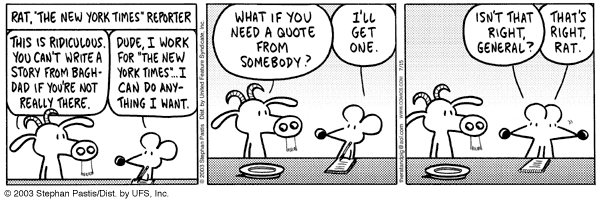
I'm always pleased when pop culture openly teases stodgy establishements like the New York Times. Pearls Before Swine is created by Stephen Pastis.
I am officially declaring the debate about when blogs have gone / will go mainstream over, based on two news items that crossed my path today. The first is this article in today's Philadelphia Inquirer, which notes:
Sad as it may be that the Philadelphia book critic has to say it, I'm shocked, shocked, and, well, just appalled. If anyone tried to pull off this kind of inbred, taking-care-of-friends favoritism in government or business, the nation's media outlets would scream bloody murder, blogging the story to death, demanding resignations and apologies.
 Emphasis mine. No footnote or parenthetical explaining what blogging is to the great unwashed ... just a verb, dropped in there like all Philadelphia readers should know what it means. (Of course we'll set aside for the moment the fact that not one of the nation's media outlets runs a truly candid blog. In fact, does this author actually think "blogging" is a synonym for "rehashing?")
That's Mainstream Sign #1. Here's #2, courtesy tomorrow's Washington Post: 'AOL Journals' To Bring Blogs To Millions. ("AOL has dubbed its service 'AOL Journals' because its surveys showed that members found the word 'blogs' confusing, said Rick Robinson, AOL's vice president for community products." Thanks for clearing that up, Rick ... we stoopid people no longer have to be confused! Sorry, have to run ... I need to finish washing the "Horseless Carriage.")
Hate to tell you, but I think we all just jumped the shark.
Newsweek has released its latest poll re: the Democratic Nomination. Bottom line: The Dean and "Don't Know" camps are cannabalizing the Liberman / Kerry / Edwards camps. See more here.
I've moved the site to a new database (SQL for interested geeky parties) and completed a full reinstall of Moveable Type ... so the comments work, and the archives are no longer screwed up. Some errors may pop up, though, as I get bugs worked out ... just click "cancel" if your browswer asks you to "debug."
In the spirit of the post below, I offer my readers, the blogosphere, and the greater Internet THIS. Hot off the TiVo at tonight's Avocare Simpsonfest. At the risk of lawsuit, and in the interest of greater humor. Because that's the kind of guy I am.
 Simpsons festival at my house, right now. Y'all wish you were here. Really. To get a bit of the mood, check out this Homer Simpson Quote Generator.
Oh, and while reasearching this post (every Avocare post is thoroughly researched, if not spell-checked), I found this, which is, I think, quite wrong. To bitch at Fox, send an email to askfox@foxinc.com.
Blogging + Drinking = Blinking
Tonight, it's about contests. Since her comments work, go ahead and enter.
And here's a little something extra, just for Michele.
Go ahead! Sing along!!
Well, woke up this morning with a wine glass in my hand.
Whose wine? What wine? Where the hell did I dine?
Must have been a dream I don't believe where I've been.
Come on, let's do it again.Do you...you, feel like I do?
How'd ya feel?
Do you...you, feel like I do?My friend got busted, just the other day.
They said,"Don't walk, don't walk, don't walk away."
Drove him to a taxi, bent the boot, hit the bag.
Had to play some music, wonder why's he [brag or drag].Do you...you, feel like I do?
How'd ya [turns from mic, can't catch it]?
Do you...you, feel like I...Do you...you, feel like I do?
Yes ya do.
Do you...you, feel like I do?Champagne for breakfast and a Sherman in my hand.
Peached up, Peached Ale, never fails.
Must have been a dream I don't believe where I've been.
Come on, let's do it again.Do you...you, feel like I do?
How'd ya feel?
Do you...you, feel like I..."Bob Mayo, on the keyboards. Bob Mayo"
Do you feel like we do?
Do you feel like we do?
Oh, that's true.
Do you feel like we do?
Get back.
Do you feel..do you feel like we do?Oh baby do you feel?
Oh baby do you feel, feel like we do?
Do you feel...do you feel...like we do?
I want to thank you.
Do you feel like we do?
That's alright, that's alright to feel you'd like,
Feel you'd like, a good time.
We'll goto bed and good night.
Good night, good night, good night, good night, good night.
Just another little post in our journal o' life. Back in Philly; Detroit was a rush of there to there with very little here in between. But it's always good to return home, and although Wife is enjoying Apples, I'm biding time until her return by siting on the deck, in a perfect evening breeze, digging the 70's DirecTV music channel, and grilling a burger.
Oh, and of course, getting my drink and smoke on.
I wonder what Michele's up to? Is tonight ABBA or Tool? Jose or Merlot? Wagers, anyone?
Of course, if the freakin' comments worked, you could place a bet. But since they don't, you can't. So we'll all just speculate amongst ourselves.
Back in business, baby!
The ThinkPad is again humming away. An easy fix, really: all it took was installing the new hard drive, creating a custom boot disk, partitioning the drive, formatting the drive, reformatting the drive so it would boot as a system disk, finding the custom external CD drivers, further customizing the boot disk to load said drivers, spending three days researching why large executable files wouldn't load off the CD and why the six-floppy set of Windows XP boot disks produced a Blue Screen Of Death with an “UNMOUNTABLE_BOOT_DEVICE” error, exploring possible USB CD drive driver alternatives, and finally, finding and downloading a CD driver boot disk off a Russian-language web site, rebooting, and loading Windows XP setup.
Did I mention I'd like one of these?
Oh, and I hope to get the comments here fixed ... this weekend? Bear with me, please.
This is a bit late, but before Independence Day cools to room temperature, you may want to visit Sheila O'Malley's site and read from her collection of 7/4 postings. She's posted some interesting material from a variety of sources; history buffs will be particularly pleased. Besides: redheads rock.
Oh, and my cohort Michele has the 7/4 linkage going on, too.
And finally, don't miss that we've launched a "2004 US Presidential Election" page over at The Command Post.
Here's hoping, if you're a Yank, you had a good one. It was certainly good here in the cradle of democracy.
For me, Independence Day is a favorite holiday. My tradition is to spend the day chasing one interest after the next, and then as night falls, smoke a cigar, drink a glass of very fine, very old scotch, and read the Declaration of Independence and Gettysburg Address.
Tonight Wife and I even added the community fireworks display, sharing the "oohs" and "ahhs" with several thousand fellow citizens. The night was without a cloud, the temperature warm and comfortably humid, our fellow Americans in good spirits.
If that's not cause for a favorite holiday, well, you shouldn't enjoy a favorite.
Some other things that make Independence Day special:
A Capitol FourthThis particular Independence Day is also special because today Michele and I started this web site. Without asking any government for permission. With access to a free press. Without fear of reprisal.
We could do so for two reasons: these people believed in ideas, and they believed some ideas are so important as to be worth extreme personal risk.
And finally, today is special because of this man's sacrifice, and the sacrifice of his peers. May their families find peace.
This is a holiday of fun, family, and fireworks. But it should also be a holiday, if only for a moment, of reflection. Here's a link to the Declaration of Independence. Read it. Start a tradition of your own.
First the cell phone, then the laptop, now the blog. Yes, the comments and trackback aren't working. Seems to be a database problem, and I hope to fix it tomorrow.
Remember this mantra: "Shackle the new media."
Tony forwards a link that will bring back great memories for anyone from Gen W or X. It may also keep you from accomplishing anything productive for the next 60 minutes. Go here, and have fun.
Just returned from Detroit, and because my laptop is still functional only as a very, very expensive paperweight, I wasn't able to post while away. Sorrys all around.
I was able, however, to spend the flight time digesting the latest Atlantic Monthly, which as usual served up several items of interest. One was an article by several Rand analysts about "ten international-security developments that aren't getting the attention they deserve." They are:
The Wall (that Israel is building)How many of these issues are on your foreign policy radar screen? Read the article here.
A Shrinking Russia
The Hindu-Muslim Divide
AIDS And African Armies
The Tehran-New Delhi Axis
Anti-Satellite Attack
Defense-Industry Goliaths
The Carrier Shortage
The Indus Water Fight
Urban Warfare
Also in this month's AM is this article about the clemency memos Alberto R. Gonzales—widely regarded as a likely future Supreme Court nominee—prepared for GW when he was Gov of Texas. In the words of the author, "they suggest that Gonzales repeatedly failed to apprise Bush of some of the most salient issues in the cases at hand." Both I and an esteemed colleague read this piece and found it very compelling ... read it, and be the first on your block to say you saw the confirmation fight coming.
One of the blogging women I dig, Rachel, has posted the latest in her long series of Michael Moore Is A Liar pieces, this time related to Moore's latest open letter to the President. A snippet:
Believe me, I read it carefully to try to discern whether or not the whole thing was a joke, and I came to the following conclusions: if it is a joke, Moore needs to take an intensive course on how not to sound like a complete psychopath while making jokes and also how to use sarcasm effectively. Also he needs severe instruction on how to actually make a point while attempting and failing at sarcasm.Mmm hmm. Unfortunately, she doesn't fisk it ... but that's OK; I'll take the opportunity to link to another Lucas On Moore post that reigns in my personal Blog Pantheon: Michael Moore Is A Lying Bastard (which, by-the-by, I believe to be true).If it's not a joke, then he has very helpfully told the world that he doesn't have a problem with lies whatsoever, which is not exactly a surprise but is still useful to have in his own words.
Oh, and some other blogging women I dig: Michele, Kathy, Jane, and although she's out of my league, Virginia Postrel.
Just in case your keeping score at home.
This today from MSNBC:
The father of a Gaza boy whose killing in 2000 became a symbol of the Palestinian uprising laid flowers at the roadside spot where he died after Israel pulled forces out of the area on Monday.The story of al-Dura is interesting. It’s interesting because footage of the dying boy, broadcast with some frequency in the West but repeatedly in the Arab world, made the boy a symbol among Arabs of the Palestinian cause and presumed Israeli brutality. It’s also interesting because many have now called into question what really happened that day, but with little recognition. And finally, it’s interesting because some now question whether the controversy is itself a form of revisionist symbol creation.Mohammed al-Durra [sic], 12, was killed in a shootout between the Israeli army and Palestinian gunmen at a junction on Gaza's main highway when the revolt erupted there and in the West Bank ...
... Palestinians say Israeli troops shot Mohammed near the turn-off leading to the isolated Jewish settlement of Netzarim, and they renamed the spot the ''Martyrs Crossroads.'' The Israeli army initially apologised for the boy's death but later said gunfire from Palestinian militants had killed him.
The story is now like a snake eating it’s own tail: the creation of an iconic symbol, which was then questioned as an intentional act of propaganda, via a process which is now itself being questioned as an instance revisionist history.
Two pieces in particular illustrate the two sides ...
The first is this James Fallows Atlantic Monthly article, Who Shot Mohammed al-Dura? It leads:
The image of a boy shot dead in his helpless father's arms during an Israeli confrontation with Palestinians has become the Pietà of the Arab world. Now a number of Israeli researchers are presenting persuasive evidence that the fatal shots could not have come from the Israeli soldiers known to have been involved in the confrontation. The evidence will not change Arab minds—but the episode offers an object lesson in the incendiary power of an icon.Read the entire article, then read the second piece, this Daily Times of Pakistan article by Shehryar Fazli, titled Power Of An Icon. In part, it reads:
If tearing down the symbol does not work, the revisionists will at least try to adapt its meaning … If the symbol is to remain, then put a new value on it. In this case, attempts to disprove the official account of al-Dura’s death by placing the blame on the Palestinians, may hope to cloak the original icon and confer on it a new, customised connotation: Palestinian deceit and absolute disrespect for human life.Together, they surface many of the issues involved. More important, they highlight what the disparate Western and Arab coverage of the Iraq war also suggested: that for perhaps the first time both sides in this seeming "clash of civilizations" understand and are using the power of media to shape the discourse, and to define what the audience considers “real.”
Last night's promise of drunken behavior was fulfilled not by Michele, but by yours truly. This is today's only post, as I spent most of the day recovering from a vigorous bout with Grey and Jose. (Yeah, I know ... I'm all about fancy combinations.)
Indeed, I spent much of the day curled up in this, which was an early birthday gift from Wife. When she saw how I looked this morning, she knew it would serve me better now than later. And of course, I didn't find this site until just now ... but better late than never.
My pseudo-girlfriend Michele promises heaps of drunken blogging tonight. Me, I'm already one beer and one very large triple Grey Goose Martini in the bag. We're off for sushi (ohmyGod, are we these people? ... given that description, I think not), and will miss whatever boozeblogfest the little dead girl will create ... but I can read it in the morning, and that's the gr8 thing about blogs.
Whatever may come, let's just hope that tonight she manages to not break the Internet.
From a recent flight of Google News searches. Search term on the left; number of stories it generated on the right:
Iraq + Victory: 2,930 storiesIraq + Defeat: 2,540 stories
Iraq + Failure: 4,910 stories
Iraq + Liberation: 1,830 stories
Iraq + Occupation: 7,340 stories
Economy + 2004 + Election: 1,440 stories
Iraq + 2004 + Election: 1,110 stories
Iraq + Quagmire: 189 stories
Avocare has a very small readership. Within this readership are two distinct subpopulations: a small group of extremely seasoned webloggers (Michele, Ricky, Jane, Oskar, Rachel, and others, all of whom I am VERY fortunate to count as regulars), and a group of people from my personal life - parents, friends, colleagues - who are, on the whole, from the "web mainstream" (whatever that is).
On occasion, I will post content aimed at the latter population rather than the former, and when I do, I ask that the blog pros bear with me.
This is such an occasion.
For my mainstream folks, if you're not already reading them, Kathy Kinsley and Momma Bear at On The Third Hand have made covering the events in Iran their personal crusade. I'm not going to point to any link in particular; just visit the weblog and begin reading from the bottom up.
And for my seasoned blogger folks: You rock.
While browsing Kevin's Wizbang I came across a link to this wonderful piece of technology, courtesy David Bloom: The Iraqi Information Minister Quote Generator. And remember:
The Americans will roast these mercenaries in Al-Nasiriyah!
Tuesday my lovely wife enjoyed a birthday many consider a milestone (in the interest of marital bliss, I’ll leave the number to your imagination). During our dinner, I asked, “So what lessons have you learned in your years? If aliens dropped down to this world and asked for advice on how to live their lives, what three lessons would you try to impart?”
Her response will remain private, but here are my answers to the question:
1. Appreciate that there are people in the world who will try to do you harm. This doesn’t mean you shouldn’t trust anyone … but understand that the world really does hold people who will try to do you wrong.Note that the first two are unrelated: I've not had anything embezzled by a former business partner. How would you answer? Feel free to respond in the comments (both of you).2. Carefully manage your money.
3. That said, appreciate that the things in life that will give you the most satisfaction are nearly always free, and most often lie in the people or nature around you.
We've welcomed a new addition to the family. Two, actually ... his and hers ... hers as a birthday present, and his as, well, an early birthday present.
Having used mine for several days now, I make this claim with confidence: Quite simply one of the best pieces of technology I have used, ever. (Indeed, in terms of simplicity, elegance, and quality, at least equal to this ... something I've always considered one of the great inventions in human history.)
We have the 10G model. I've loaded 384 songs so far ... about 30 CDs worth ... and have used 16% of the storage capacity. Sound quality is incredible, battery life is 6-8 hours ... worth every last cent. And after using it on the way to and from Baltimore yesterday, I’m willing to tag the iPod a Road Warrior Essential.
It happens to each of us sooner or later. And no matter how you try to prepare, you're never really ready. Last night, around 11 PM, the keystone of my computing life died. Total hard drive crash. My life now revolves around this message: "Operating system not found."
Luckily, I practice safe computing and backup regularly, and my professional life is largely safe. The personal, though ... the digital photos, the blog postings, the stuff ... all gone.
A new hard drive is on the way, but the data have long since left this world.
(Parenthetically, if you've sent me mail in the last day, please resend. Anything that was sitting in my inbox that I’d not responded to as of last night is forever history.)
... brought to you by Bank One.
The politicians persuaded the Chicago Bears not to sell the naming rights to the team's newly-rebuilt stadium. But the Bears figured out how to get the big bucks anyway.Go here for the story, here for the Bank One spin, and here to let Bank One know what you think. Similar links for Da Bears are hard to find.Yesterday, they sold the name of the team, or came pretty close.
No longer will the old franchise, which was there at the NFL's creation, refer to itself exclusively as the Chicago Bears. From now on, whenever possible, it will be "Bears football presented by Bank One."
Today's US Supreme Court decisions in the Michigan affirmative action cases (Gratz v. Bollinger, Grutter v. Bollinger) are already producing an enormous volume of press, and I'm certain the more astute blog analyses will soon follow. I'm not so certain, however, that the decisions themselves will often see the light of day.
All told, the 9 Justices authored 13 different opinions, totaling 163 pages, across the two decisions. And thanks to the power of the Internet, both are available online, courtesy the source. You may find Gratz v. Bollinger here, and Grutter v. Bollinger here.
Don't quickly put aside the idea of reading them. I'm no attorney, but between working in law firms through college and taking multiple Constitutional Law courses in school, I can attest that most modern Supreme Court decisions are accessible and relatively easy reads. What's more, they are fascinating ... each Justice has their own style, and in cases with multiple opinions such as these, those styles - and the policies toward which the different Justices lean - become clear.
Given their historical importance, I plan to read both.
I just came across this post at Wizbang, which links to two sites that, frankly, are the geek equivalent of "Girls Gone Wild!" Mix a high IQ, ample time, an obsession with Flight Simulator, networking know-how, and 13 monitors and you get this. Toss in some coding know-how, plywood, and a cordless drill and you get this.
Either way, I'm left wondering whether I should be impressed, saddened, or, given my own affinity for FS2002, envious. Of course, ask "Where do they find the time?" and the response you'll get is likely "The same place you find the time to publish all those weblogs."
And if you wonder what it's like when geeks really do go wild, go here.
When blogrolling tonight I came across this post by Kathy at 3rd Hand. It links to this story by Dave Barry in the Houston Chronicle. Here's a sample:
We are worried, here in the newspaper business (motto: "What, YOU never make misstakes?"). We're hearing that you readers have lost your faith in us. Polls show that, in terms of public trust, the news media now rank lower than used-car salespeople, kidnappers, tapeworms, Hitler, and airline flight announcements. (We are still slightly ahead of lawyers.) ...Read the rest; Barry only amplifies his smart-ass tone.... I think the public is genuinely unhappy with us. Lately, when I tell people I work for a newspaper, I've detected the subtle signs of disapproval -- the dirty looks; the snide remarks; the severed animal heads in my bed.
How did we get into this situation? Without pointing the finger of blame at any one institution, I would say it is entirely the fault of the New York Times.
I'm glad he finds public doubt in the media's so funny. I understand that he is primarily a "humor columnist." I understand that he's won a Pulitzer Prize. But I've had enough of media arrogance, and this article is simply salt in the wounds of a public trust long since broached.
Personally, I hope the increaslingly democratized nature of public information ultimately reduces the demand for professionally sanctioned media ... reduces it to such a level that Dave Barry, and journalists of his ilk, wonder preciesly when they became so unneccessary.
Wife and I saw Peter Gabriel last night ... purchased the tickets Friday night on a lark (birthday present to me), and lo and behold, our seats were center section, about 25 rows back.
He put on a great show (as usual), designed as an encore to the first leg of his US tour last fall. Given that it was 10 years between this album and the one prior, we watched the show knowing it may be the last Gabriel concert we attend.
That said, the real find of the evening was Sevara Nazarkhan, an absolutely haunting singer from Uzbekistan. She's on Gabriel's Real World label, and you can listen to and buy her CD, Yol Bolsin, here.
Finally, a seatmate was taking digital snaps on her Palm Zire 71 throughout. It's a pretty slick little PDA - I asked her to email the snaps to me, and when she does I'll post them and we can communally judge quality.
Who knew Laurence was so afraid of Utah? Reading his thoughts on the matter, I attribute his phobia to the fact that the only Utahan he's really known was a transfer from here ... and any Ute (as am I) on the planet will quickly tell you that Cougars are not to be trusted.
At least now he has me to balance things out ... and having lived 23 years there and 11 years here, I can assure him: there are only two types of people that must fear the Behave State: Alcoholics, and people who like to drive over 40 mph in the fast lane. Oh ... and anyone who distrusts theocracy. But that's it. So fear not, Laurence ... I won't let em' get you.
Of course, given recent events, this guy might.
While trolling the online news sources this morning I came across Muslim WakeUp!, a site
committed to an understanding of Islam that challenges human beings to act on behalf of the divinely inspired principles of love, justice, and a belief in the unity of all God’s creation.What's more, the site
seeks to mirror the diversity, dynamism, and creative spirit of Islam. We will celebrate all that is alive with meaning in our lives—spirituality, music, art, literature, politics, laughter, love, compassion—everything that is close to the heart. We will speak our mind for what we feel is right, especially when it conflicts with what we are accustomed to—all the time seeking God’s guidance and forgiveness.And here's another interesting twist: the site's a blog, running MT 2.63. Anyone want to raise the "when are blogs mainstream" question one last time?
If you've not read it already, Michele is temporarily blogging from here whilst Stacy returns A Small Victory to its usual glory. I had no idea the post prior to this would be so prescient.
While on the topic of top-shelf female bloggers, I've been increasingly enamored with Virginia Postrel's work. If you're not reading Dynamist Blog regularly, you should be. Note that Virginia has the tendency to post in the wee hours, so don't necessarily trust your blogroll to tell you when she's up-to-date.
It's Shoutout Friday Night here at Avocare Radio ... our next request is from Michele to Stacy, with love.
Although she was more hardcore earlier in the evening, Michele tells me she's listening to bad 70s music tonight ... whaddayaknow, so are we. This is for Michele.
Games, by RedeyeSee how they run
Taking a ride on an everyday fight to nowhere
Run inside it's a great place to hide themselves
And you know
Yeah you know
Yeah you know
Yeah you know
You know what they're doingCan't they see
The dreams in the mind are the only thing
That bind them together
Serving the purpose until
They turn it away for dead feeling
And you know
Yeah you know
Yeah you know
Yeah you know
You know what they're feelingYou play the game
Take it while you can
Don't you give it to the man behind you
You can put it down 'til
You pick it up again
If you want to
And you know
Yeah you know
Yeah you know
Yeah you knowYou know what you're doing.
 Speaking of Orrin Hatch, did you realize he's a musician as well? Go to The Music of Senator Hatch and see for yourself. Here's a snippet from the site:
Soon after his debut with Janice [Kapp], singer, songwriter Billy Hinsche of the Beach Boys' approached Orrin about writing with him. Following their sixth song, Marilyn Bergman of ASCAP (a performance rights royalty organization) contacted Orrin to inform him that his songs had "great potential" and that she was passing them on to Donna Hilley, head of Sony/ATV Tree in Nashville. She felt Donna was in a better position to advise Orrin about the future of his songs.Buy your CDs online.Donna called Orrin and explained, "On any given day in Nashville we receive 200 good songs. What we are interested in is great songs." Orrin was sure this was her way of letting him down; however, she responded, "We think two of the songs are great songs and that they'll be around for 100 years or more. We would like to demo them for you. Would you be interested in coming down to see how we do it?"
As a former Utahan, I'm never surprised when I hear about some half-baked story that involves Orrin Hatch. After all, this is the same guy who, when chairman of the Senate Intelligence Committee, told 17-year-old me that Ferdinand Marcos wouldn't be out of power anytime soon. Twelve months later, we were reading about Imelda's shoes.
So when the whole "destroy the pirate's PC" thing broke, I just shook my head and thanked God that one can still depend on something, even if that thing is Orrin Hatch.
And when I read this story at Wired - which reports pirated software running on Hatch's website - I added a good snort to the head-shaking. Of course, it should come as no surprise that Laurence (today playing the part of Bob Woodward) is involved ... he has one cent on the topic here and a second here. Toss both in your pocket.
I'll tell you how much I love my wife: so much that, even though this is my only day home this week, even though I'm sick with some cursed summer cold, even though it's 90 degrees and humid on the East Coast ... I still decided to spend my day driving to the Meadowlands and mingling outdoors with 20,000 people who look a lot like these guys, but are crazed fans of these guys.
Only in Jersey can you celebrate a world championship in a parking lot, tailgate style. Nonetheless, the faithful were out in force, the team was in good spirits, and of course, Stanley was there. And it sounded like this.
So I’m sure both of you are wondering what happened on the way home.
Just a day in the life … but it was a day that illustrates why one of my colleagues says that people don’t pay us for expertise … they pay us to travel.
It started with my drive to the airport in Minneapolis. Let’s just say I was cutting things a bit close … so close, in fact, that for the first time in 10 years of travel I abandoned the rental car at the Hertz facility.
Just left it.
Looked at the checkout guy. Yelled: “Tank is full, keys are in it.” Ran for the terminal. ‘Cause if I miss that flight, I’m going MSP-Charlotte-Philly and getting home at midnight.
I did make the flight, and ended up in … Pittsburgh. It seems the entire Northeast was in weather-related travel lockdown hell, and every 737 between Atlantic City and St. Louis was paying the price, flying endless racetracks over agrarian America, waiting to divert to other destinations and take on fuel. We went to Pittsburgh … which is good, because it’s East. Divert to Chicago on a Friday night, and you’re coming home Saturday.
And despite the promise of a 15-minute refuel in Pittsburgh, this diversion turned into a 90 minute gate hold due to a full ground stop for traffic into Philly. We did finally leave, and I got into PHL somewhere around 9:00 PM EST.
On the whole, I like the travel. And days like this: they’re just part of the job. They’re nobody’s fault; there’s nothing worth getting pissed about. But they do amplify your longing for home, and they do take a toll on your body, and some days, they take a toll on your soul. And if you’ve not lived the life of one of this company’s top 500 fliers, they can be hard to appreciate, especially after this (a day, BTW, in which I was on an early-morning flight to Chicago).
So I'm pretty shredded. Luckily, Wife has infinite patience and reservoirs of appreciation. I wonder how patient she’ll be when she learns we may have just bought one of these, courtesy Hertz?
Back in Philly after two very busy days in Minneapolis. Getting home was hell ... but more about that later.
In the meantime, this is a very cool site. And you can see two of my favorite locations here and here.
While on the plane from Denver to Philly today I read most of the most current Atlantic Monthly. It has a number of articles worth reading, one of which is available online: an excerpt from the afterword to Michael Kelly's book Martyrs' Day. Another compelling read is an account of the "Logic of Suicide Terrorism" by Bruce Hoffman. (That article alone makes the current issue worth buying.)
Also noteable from the trip back: SLC is sporting the new magnometers at security ... plan on stripping down to your skivvies to pass through without being wanded. The pilot from DEN to PHL also did something I've not seen recently: he led the first part of the pre-flight announcment from the front of the cabin. Not only did he manage to entertain, he also admonished everyone to not "loiter" in the galley area by the door to the flight deck. He was personable and funny, but the subtext was clear: "stand by my door, and I'm treating you as a hostile."
I wonder if he was one of these guys?
I found this link some time ago via Virginia Postrel's blog, and have thought of it often since then. Not only do you get to learn your Myers-Briggs type, you also get to help a striving student collect data for his undergraduate thesis.
And if you're a natural skeptic (like me), go here.
You may not have noticed ... probably because US media is ignoring the story almost in its entirety ... but Paris is going to hell over a pension reform-related strike. Glenn Reynolds at Instapundit provides a host of links that add up to a good primer. Start here and read down.
Ran across this tonight and thought it simply screamed "caption contest" ...

Post your caption ideas in the comments ... a small sliver of glory for the winner.
... but this style of media scares the shit out of me. Also, note that this DOESN'T come from the Op/Ed section. Say what you want about US foreign policy, but with press like this it’s no wonder the world hates us.
 This comes today from Tony. I post it here for Don in particular, but really for anyone reading who appreciates perfection. Simply: Oh. My. God. Click the pic to get the full monty.
Good friend, musician, and recording engineer Tony is going low. But where does he find the time?
Things are cold here tonight, regardless of the official report. The cold front blew in from Anaheim, and we're hoping for a warming trend soon. If everything goes well, we can all eat ice cream out of the largest ice cream bowl in the world.